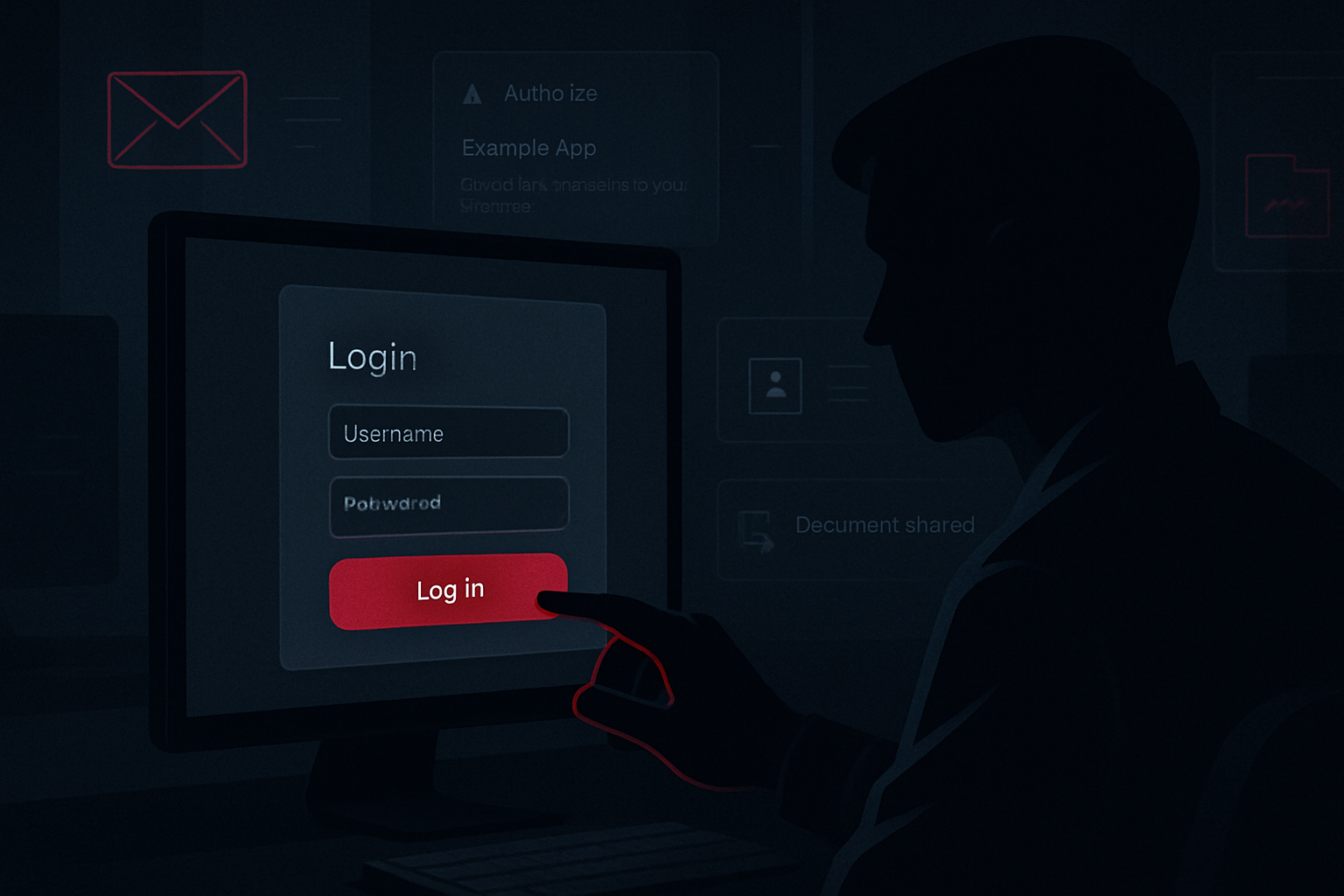
The most effective cyberattacks rarely break anything. They ask nicely. A message from IT support, a shared file link, a prompt to authorise an app—these work because they exploit something no firewall can stop: the expectation that colleagues and familiar systems are trustworthy. Understanding why this approach dominates modern threat activity reveals uncomfortable truths about how authentication and access control actually fail in production environments.
Trust as Infrastructure
Modern organisations build their identity systems on implicit trust. When an employee receives what appears to be a Dropbox share from a colleague, they click without verification. When an OAuth prompt appears for a tool they use weekly, they authorise without reading permissions. This isn't user negligence—it's the rational response to systems designed around convenience, not paranoia.
Attackers have understood this asymmetry for years. Rather than exploit a zero-day vulnerability in your web server, they register a domain one character away from your login portal. Rather than crack a password, they use a password reset flow the user never actually completed. Rather than break OAuth itself, they create a malicious application and wait for someone to click 'Allow.'
The infrastructure that enables business—email, file sharing, single sign-on—becomes the attack surface. And unlike a patched vulnerability, this surface doesn't shrink when you update your systems.
Why Scale Makes This Worse
Consider the reported compromise of 5,000 Dropbox accounts. Mass account takeover typically doesn't require breaking Dropbox's security. It requires harvesting credentials somewhere else—via phishing, malware, or credential reuse across services—then checking them against Dropbox's login endpoint. The attacker needs no insider knowledge, no advanced exploit, no zero-day. They need patience and a list of email addresses.
The same principle applies to CEO-targeted phishing kits. These aren't sophisticated: they're domain spoofs and HTML forms that capture passwords and multi-factor codes. Their success depends on timing (targeting Friday afternoons when IT support is slow) and contextual detail (referencing a real ongoing project, real vendor name). An attacker can run hundreds of these campaigns in parallel, recycling the same basic infrastructure across multiple targets.
From an infrastructure perspective, this reveals why perimeter-based security—firewalls, IDS, WAF—fails to stop phishing. The attack happens outside your network, on infrastructure you don't control. Your users are the attack surface. Their inboxes are the entry point.
The OAuth Problem
OAuth delegation creates a specific vulnerability when users don't verify which application they're authorising. An attacker can register a seemingly legitimate app—'Google Backup Manager', 'Microsoft Account Sync'—and present users with a standard OAuth consent screen. The user sees only the familiar Google or Microsoft login page. They don't question what permissions the malicious app will receive.
This works because OAuth was designed for intentional integrations, not adversarial scenarios. The consent screen assumes the user is authorising a tool they chose. It doesn't account for social engineering or domain spoofing that led them there.
Infrastructure teams can't fix this through technology alone. OAuth token revocation, IP restrictions, and device verification help, but only if users understand what they're delegating and to whom. That requires training, and training fails against a well-crafted attack.
What Actually Works
Detection, not prevention, becomes the realistic goal. Monitor for suspicious OAuth grants—new applications with unusual permission sets, logins from unlikely geographies, bulk password reset requests. Log every authentication event. Make lateral movement detectable: if an attacker obtains credentials, ensure they can't move freely through your systems without triggering alerts.
Implement authentication methods phishing can't intercept. Hardware security keys require physical access and prevent credential capture. Time-based OTP codes are harder to phish at scale than SMS or app-based codes, though not impossible. Push notifications that users explicitly confirm offer better protection than silent background checks.
Segment critical infrastructure. A compromised employee account shouldn't grant access to production databases, domain controllers, or billing systems. Require re-authentication for sensitive actions. Monitor for impossible travel—the same account logged in from different continents within minutes—and block it.
The uncomfortable reality: no technology fully stops phishing because phishing exploits human behaviour, not a broken system. The best infrastructure teams recognise this and design around it: assume accounts will be compromised, then limit the damage when they are.
More recent threat reporting confirms phishing remains the leading infection vector for ransomware and data breaches. The tools and techniques stay simple because simplicity works. Defending against this requires not just better controls, but a realistic understanding of where the actual weakness lies: in the design of trust itself.