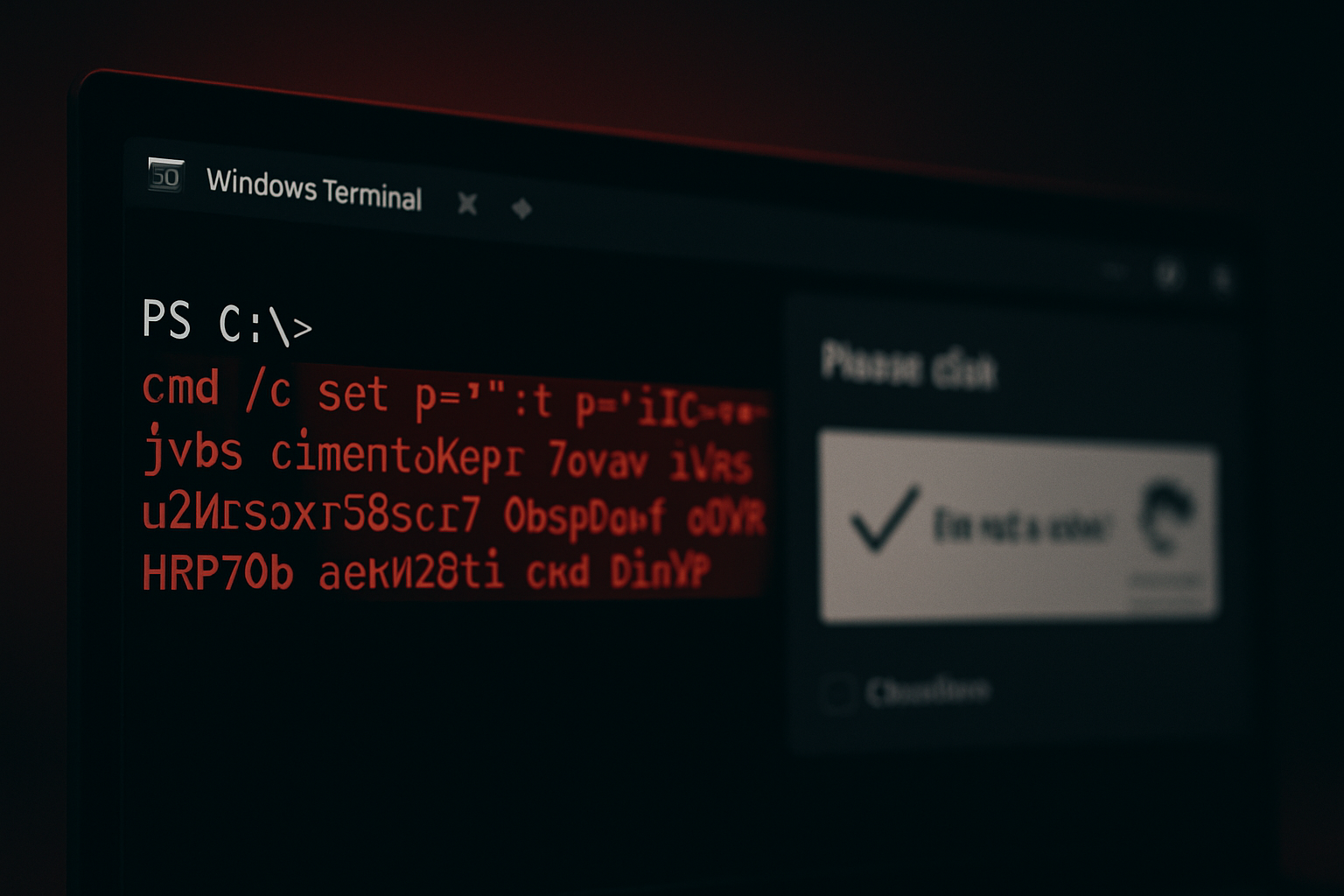
Security researchers at Microsoft have documented TerminalFix, a social engineering campaign that represents a meaningful refinement of the ClickFix attack family. Rather than directing victims to the Windows Run dialog, TerminalFix pushes targets toward PowerShell or Windows Terminal—environments where complex command execution is both expected and harder to scrutinise.
The Attack Surface and Social Engineering Vector
TerminalFix operators employ convincing replicas of Cloudflare's CAPTCHA interface to create a false sense of legitimacy. When a user lands on a compromised or attacker-controlled webpage, they encounter what appears to be a routine security challenge—a familiar Cloudflare CAPTCHA prompt. The perceived need to complete this verification step is the psychological hook. Once the victim interacts with the fake interface, they are directed to open a terminal emulator and paste or execute a command string.
This approach exploits several human factors. First, Cloudflare CAPTCHAs are ubiquitous across the web; most users recognise them as legitimate. Second, terminal commands are inherently text-based and difficult to parse visually at a glance. A long, encoded, or obfuscated command string can be difficult to distinguish from legitimate system administration tasks, especially under time pressure or distraction. Third, many users trust that if a well-known service like Cloudflare is involved, the subsequent action must be safe.
Reverse Tunnels and Persistent Access
The payloads delivered through TerminalFix establish reverse-tunnel backdoors, rather than conventional direct shells or file-dropping malware. A reverse tunnel inverts the typical client-server model: the compromised machine initiates outbound connections to an attacker-controlled server, then receives commands and access requests through that established channel. This design provides several operational advantages for threat actors.
Reverse tunnels bypass many firewall and network segmentation controls because they originate from inside the network boundary. A host running a reverse tunnel can tunnel traffic back through that connection, effectively giving attackers remote access without requiring inbound ports or direct network routes. For server operators and infrastructure teams, this means a single compromised workstation can become an entry point for lateral movement into otherwise protected systems.
The persistence model is also noteworthy. Unlike a one-time file-drop or payload execution, a reverse tunnel remains active as long as the process runs, giving adversaries sustained access for reconnaissance, credential theft, or further propagation.
Implications for Infrastructure Teams
The refinement from Run dialog to terminal emulator signals that attackers are adapting to user awareness. Many organisations now warn employees about suspicious Run dialog prompts. Windows Terminal and PowerShell, however, remain daily tools for system administrators and developers. An attack that blends a fake CAPTCHA with a terminal command can more easily evade user suspicion in environments where command-line work is routine.
For infrastructure operators, the key concern is supply-chain and endpoint compromise. A developer or junior admin whose workstation is compromised via TerminalFix may have legitimate SSH keys, VPN credentials, or API tokens stored locally. The reverse tunnel provides attackers with a persistent foothold from which to pilfer those credentials and move laterally into hosted systems or administrative consoles.
Detection and response hinges on endpoint monitoring. Security teams should track unusual spawning of reverse-shell processes, outbound connections from terminal applications to unexpected IP addresses, and parent-child process relationships that suggest terminal emulators launching network tools. Network-level detection of reverse tunnels often requires inspecting encrypted traffic or monitoring for symmetric bidirectional data flows on uncommon ports.
Defence Strategies
Organisations should enforce application whitelisting on critical workstations to restrict which tools can establish network connections. Code-signing policies and execution guardrails in PowerShell (Constrained Language Mode, Script Block Logging) add friction to arbitrary command execution. Regular security awareness training that emphasises never pasting terminal commands from untrusted sources remains essential—no technical control can replace human judgment.
For teams managing hosted infrastructure, the lesson is clear: assume that endpoint compromises will occur, and design network segmentation and access controls accordingly. Reverse tunnels are effective precisely because they work with the network, not against it. Microsegmentation, requiring multi-factor authentication for administrative access, and maintaining clean audit logs of all outbound connections from critical systems are foundational defences.
TerminalFix demonstrates that social engineering attacks continue to evolve in sophistication and targeting. The threat is not exotic; it relies on trust, familiarity, and the natural friction between security and usability. Vigilance and a defence-in-depth posture remain the most reliable countermeasures.