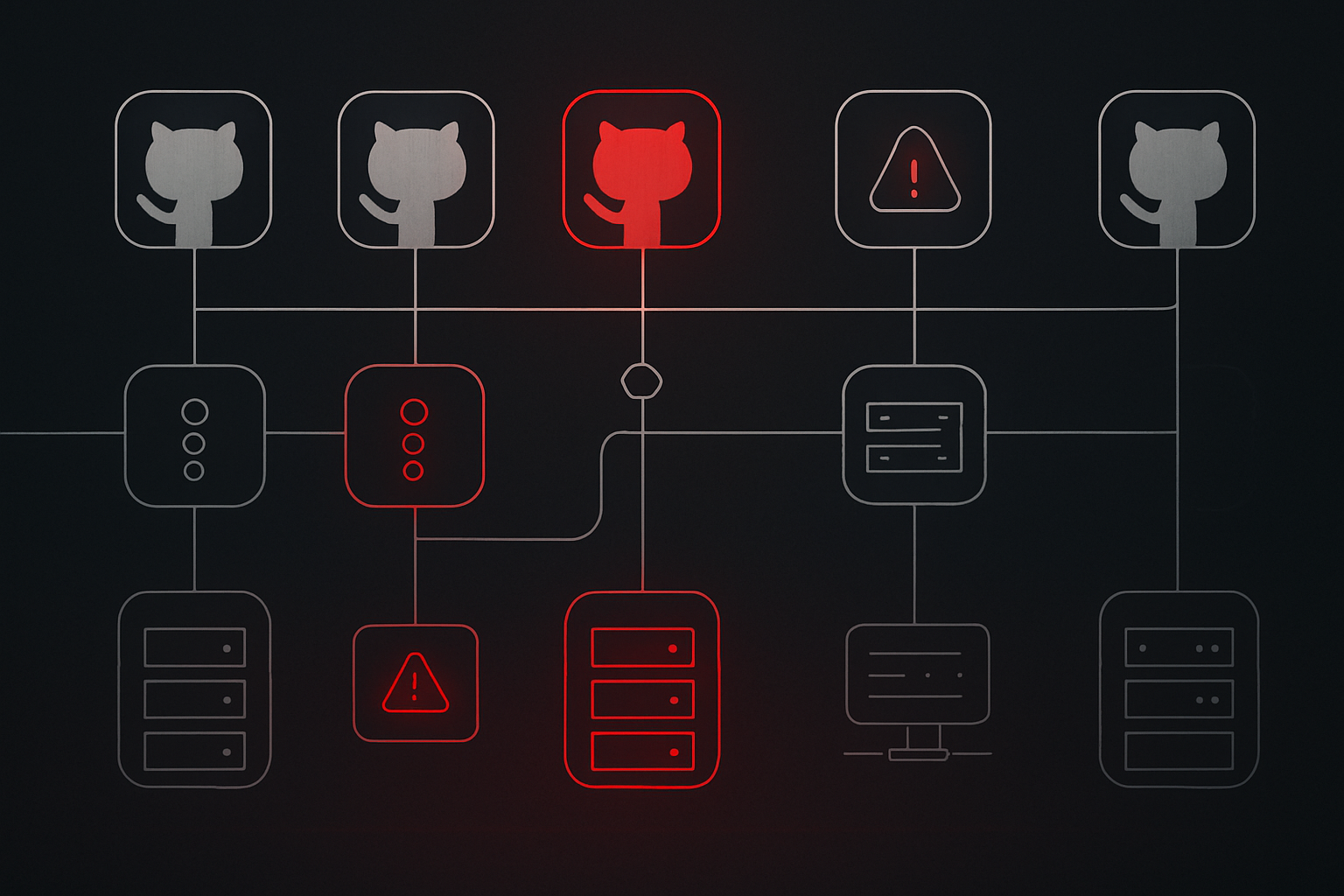
The discovery of nearly 7,600 malicious GitHub repositories, many masquerading as AI tools or Model Context Protocol servers, reveals a maturing threat model that should concern anyone responsible for infrastructure, CI/CD pipelines, or dependency management. The campaign, tracked as FakeGit, demonstrates how attackers can operate at scale by exploiting the implicit trust developers place in open-source ecosystems.
Attack Surface: Repository Cloning at Scale
FakeGit's approach is mechanically straightforward but operationally sophisticated. Threat actors copy legitimate project structures, create near-identical developer profiles, and craft convincing README files to lower friction at the point of discovery. Developers searching GitHub for an AI library or MCP server implementation encounter these repositories before—or alongside—legitimate alternatives, and the barrier to installation is just a single command: git clone or npm install.
The scale itself is the message. Seven thousand repositories suggests not a targeted operation but an industrial one: likely using automation to fork, modify, and republish across multiple accounts. Each repository is a potential infection vector, and each developer who clones one assumes they're adopting a tool rather than malware.
Why This Matters for Infrastructure Teams
For operators of hosting infrastructure, VPS platforms, or managed cloud environments, this threat has two immediate implications. First, if a compromised dependency lands in a customer's build pipeline or containerised workload, the resulting compromise may originate upstream—making it difficult to trace back to a single repository or package. Second, the FakeGit pattern (convincing presentation, legitimate-appearing history, high discoverability) is now a proven template. Attackers will iterate on it.
Supply chain attacks shift the locus of vulnerability from your own code to code you trust. A developer pulls what they believe is an innocent utility; the utility phones home or modifies build output; your infrastructure becomes an unwitting participant in the attacker's goals. Detection becomes harder because the malicious code wasn't introduced by you—it arrived from upstream, often with no obvious red flags at deploy time.
Defence: Mitigating Dependency Risk
There is no perfect countermeasure, but several practices reduce exposure. Pinning dependency versions and hashes forces conscious updates rather than automatic pulls of the latest code. Requiring code review before any dependency change goes to production, even for seemingly minor library updates, catches anomalies. Running dependencies in isolated environments—containers with minimal permissions—limits blast radius if compromise occurs.
Monitoring for suspicious behaviour during builds—unusual network connections, unexpected file system writes, cryptographic operations—can flag compromised dependencies before they reach production. And scanning repositories for known malware signatures, though reactive, remains standard practice. However, as documented in the FakeGit analysis, sophistication of modern supply chain malware means signature-only detection will always lag behind new variants.
The Structural Problem
Ultimately, FakeGit succeeds because open-source ecosystems rely on signal-to-noise ratios that attackers have learned to game. A repository with a plausible name, a few commits, and a well-written README passes the heuristic checks most developers use before adoption. GitHub's search and discoverability algorithms favour activity and relevance, not authenticity verification. And there is no enforceable guarantee that a repository belongs to who it claims to be.
For infrastructure teams, the lesson is simpler: trust is not a security control. Assume that at least some upstream dependencies will be compromised at some point. Build infrastructure defensively—with sandboxing, permission isolation, and network segmentation—so that a malicious dependency doesn't automatically become a persistent threat to your systems.