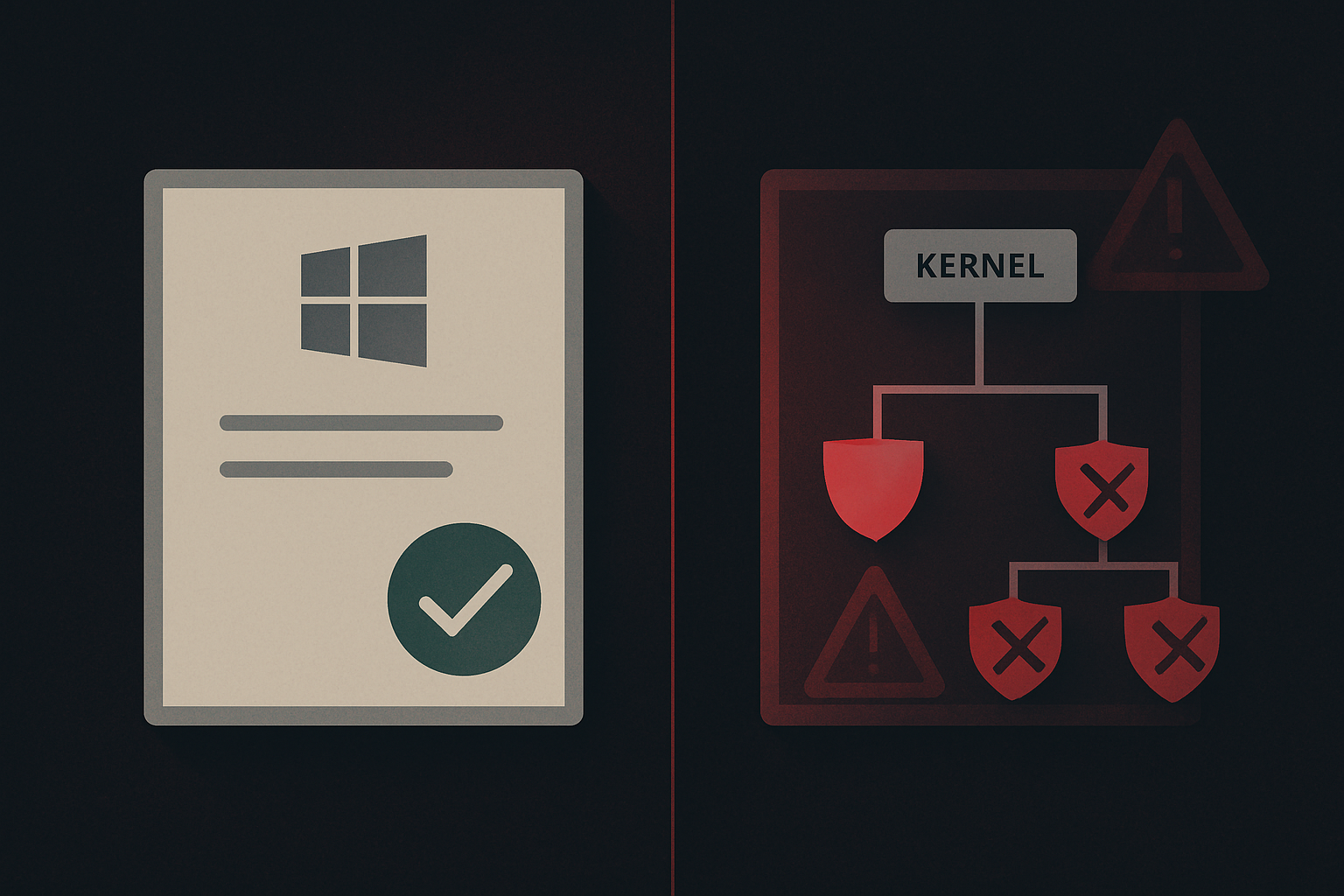
Last September, researchers identified a sophisticated attack chain that began with a convincing but malicious LastPass Authenticator installer hosted on GitHub. The payload was not a simple information stealer—it involved a Windows kernel driver, legitimately signed by Microsoft's own hardware-compatibility programme, that systematically disabled antivirus and endpoint detection and response (EDR) tools before a password stealer executed. The driver's pristine signature made static analysis nearly useless: it scored zero detections on VirusTotal despite its malicious purpose.
This attack pattern exposes a fundamental tension in modern Windows security architecture and has direct implications for anyone deploying workloads on shared or dedicated infrastructure.
The Signature Problem
Microsoft's driver-signing programme exists to ensure that kernel-level code meets hardware compatibility standards. The process is meant to prevent unsigned or obviously malicious drivers from loading on production systems. However, there is no mechanism that prevents a legitimately signed driver from being deployed for malicious purposes after creation. Once a driver is signed, Windows trusts it implicitly—the signature proves authenticity and pedigree, not intent.
An attacker who obtains a valid signing certificate, or who submits a driver that appears benign during the certification process, can later distribute that same driver as part of an attack chain. The signature remains valid because it is cryptographically correct. The Windows kernel loads it without question. This is not a bug in the signing mechanism itself; it is a design choice that assumes downstream use will remain benign.
In this case, the driver was able to interact with security software at the kernel level, terminating processes and disabling protection mechanisms that typically operate at higher privilege levels. The attacker had essentially gained trusted execution context—something that would normally require administrator credentials or a genuine vulnerability.
Supply Chain and Distribution
The attack began with a fake LastPass Authenticator installer on GitHub. GitHub is a trusted platform for developers, which lowers the psychological friction for potential victims. The installer itself was not obfuscated; it simply executed payload code that loaded the signed driver. Anyone running the installer as administrator (a common habit for application setup) would inadvertently load kernel-level malware.
This illustrates a broader supply-chain weakness: compromised or counterfeit tools distributed through trusted platforms. The problem is not unique to GitHub—package managers, download mirrors, and software repositories all represent high-value targets. As researchers from LastPass and Delphos Labs documented, the attack required no zero-days and no Windows vulnerabilities. It was effective purely because it combined social engineering (a plausible fake installer) with a legitimate, signed execution path.
Implications for Infrastructure Operators
For teams managing dedicated servers, VPS infrastructure, or private datacenters, this attack pattern highlights the risk of administrator-level code execution. Even if you operate Linux exclusively, any Windows systems in your infrastructure—whether for management, monitoring, or customer workloads—are potential entry points if endpoint security is disabled at the kernel level.
Several hardening practices become more critical in this context. First, code-signing verification is necessary but not sufficient; you must assume that signed code can still be malicious. Second, behavioural detection (monitoring for antivirus/EDR termination, driver loading, or suspicious process spawning) is essential—signature-based scanning will miss signed malware. Third, strict application allowlisting on critical systems can prevent execution of unauthorized installers entirely, even if they come from normally trusted sources.
Organizations should also enforce code-signing policies at the driver level where possible, using techniques like kernel patch protection and UEFI Secure Boot to limit unsigned driver loading. Monitoring kernel-mode operations and maintaining detailed endpoint telemetry becomes especially important when traditional antivirus tools have been disabled.
The Broader Lesson
This campaign demonstrates that trust mechanisms—whether cryptographic signatures, platform reputation, or code provenance—are useful but incomplete safeguards. A digitally signed driver from Microsoft is trustworthy evidence of provenance, but it is not a guarantee of safe execution. Infrastructure operators and security teams must operate with the assumption that signed code can be weaponized, and that traditional detection tools can be disabled by code running at higher privilege levels.
The attack required no sophisticated exploits, no supply-chain compromise of Microsoft itself, and no zero-day vulnerabilities. It succeeded because attackers understood the gap between identity verification and intent verification, and because many users still treat installer prompts as rubber-stamp approvals rather than security boundaries. Defending against it requires moving beyond signature-based detection to behavioural analysis, privilege restriction, and continuous verification of system state.