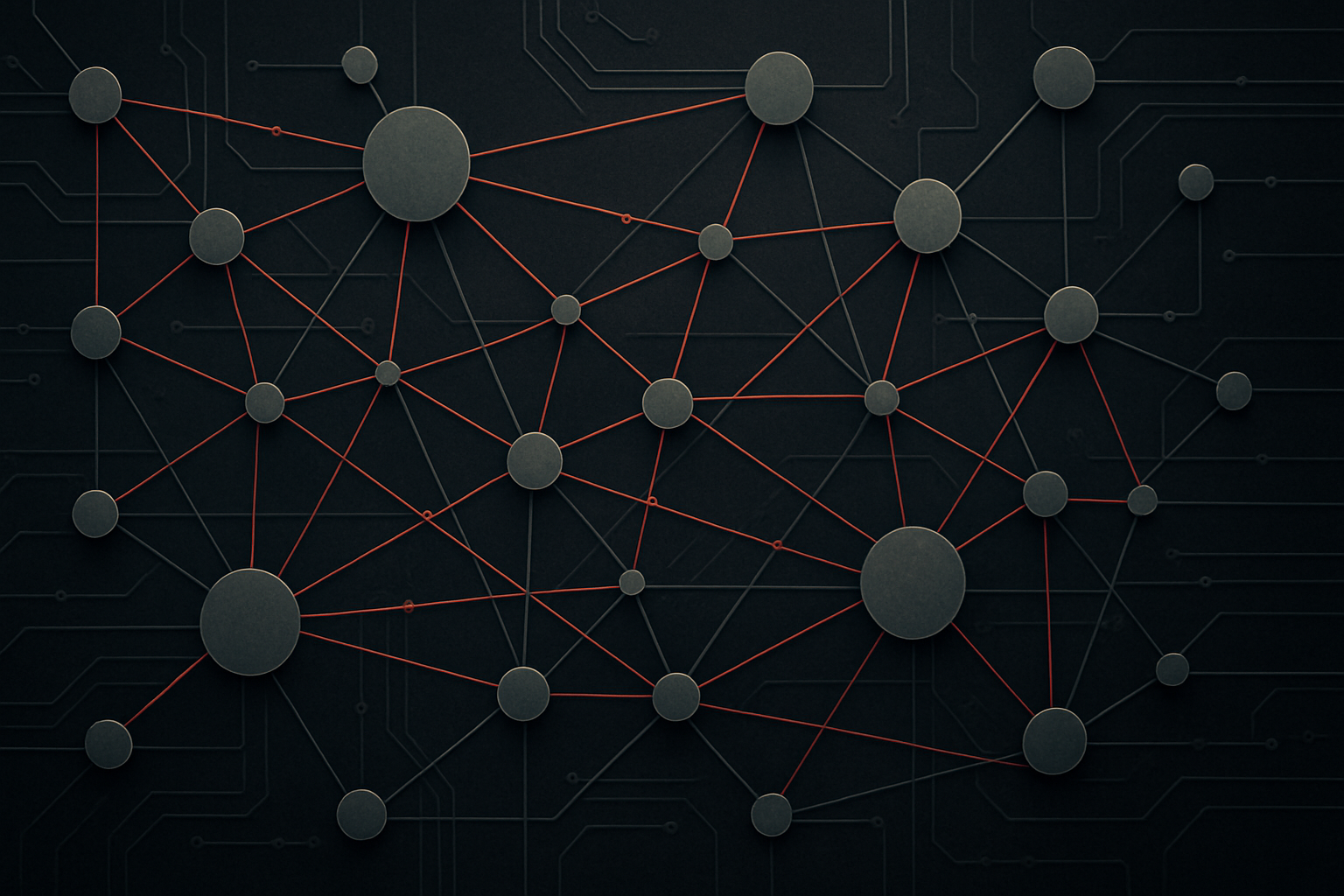
The shift toward decentralized infrastructure has long been a theoretical interest in academia, but recent work from researchers at Delft University of Technology demonstrates practical applications that challenge conventional hosting assumptions. Their two-decade effort on Tribler, a decentralized BitTorrent client, now extends into infrastructure design itself—specifically, self-replicating seedbox architectures that operate without central points of control or failure.
Beyond Traditional Hosting Models
Conventional web infrastructure relies on a hierarchy: domains point to nameservers, nameservers resolve to hosting providers, and hosting providers control the actual compute. This model has undeniable benefits—simplicity, predictability, established billing relationships—but it introduces single points of leverage. A hosting provider receives a takedown notice, a government issues a court order, a datacenter loses power: the service disappears.
Self-replicating systems invert this relationship. Instead of data flowing from a central server to clients, nodes themselves become both servers and clients. Each participant in the network contributes storage and bandwidth capacity. Removal of any single node does not degrade service; the network adapts. This architecture mirrors the original vision of peer-to-peer systems from the early 2000s, but with modern refinements in discovery, redundancy, and performance.
The Infrastructure Engineering Challenge
From an operational standpoint, decentralized seedbox designs raise familiar but inverted problems. How do you monitor a system with no central dashboard. How do you update software across thousands of autonomous nodes, each potentially offline at any given moment. How do you guarantee data consistency when replication happens asynchronously across unpredictable network conditions.
Traditional DevOps answers don't apply cleanly. Version control, deployment pipelines, and automated rollbacks assume centralized authority. In a self-replicating system, you must bake resilience into the protocol itself. Nodes must validate data independently. Consensus mechanisms—whether proof-of-work, voting, or reputation systems—become the actual infrastructure.
The operational overhead is significant, which explains why most commercial hosting remains centralized. But for applications where availability and censorship resistance matter more than operational simplicity, the investment in decentralized infrastructure becomes rational.
Practical Implications for Content Distribution
High-bandwidth applications have long depended on dedicated hosting because centralized datacenters offer predictable throughput and SLA guarantees. Self-replicating systems distribute that bandwidth load across volunteer participants, trading latency and consistency for resilience.
For streaming or large-file distribution, decentralized seedbox models can reduce backbone costs significantly. A single popular file replicated across thousands of peers means each peer serves a tiny fraction of the total load. The network self-scales with demand: more interest means more replication, more upload capacity, faster overall distribution.
This model works best for content that does not require authentication, personalisation, or real-time updates—archives, large datasets, published media. It struggles with dynamic web applications, databases requiring strong consistency, or services needing to enforce access controls.
The Governance Angle
Tribler's research direction toward decentralized governance is the conceptual endpoint: not just resilient infrastructure, but infrastructure whose rules and policies are themselves decentralized. This removes the single party that can be pressured to censor, modify terms of service, or shut down the platform.
From an infrastructure provider's perspective, this is both existentially challenging and instructive. It suggests that traditional hosting services—even those offering privacy and jurisdictional flexibility—may eventually compete with systems that require no hosting provider at all. That competition already exists in a limited form: BitTorrent networks run without centralised seedboxes, blockchain networks operate without centralised nodes.
The question for infrastructure operators is not whether decentralized systems replace hosting entirely, but which workloads they will eventually capture. High-reliability, low-latency applications will remain centralized. But large-scale content distribution, archival systems, and censorship-resistant applications may migrate toward peer-to-peer models as the technology matures.
For now, decentralized infrastructure remains niche, suitable mainly for projects with ideological commitment to decentralisation or extreme resilience requirements. But twenty years of research funding through 2032 suggests the field views this trajectory as serious engineering work, not theoretical exercise.