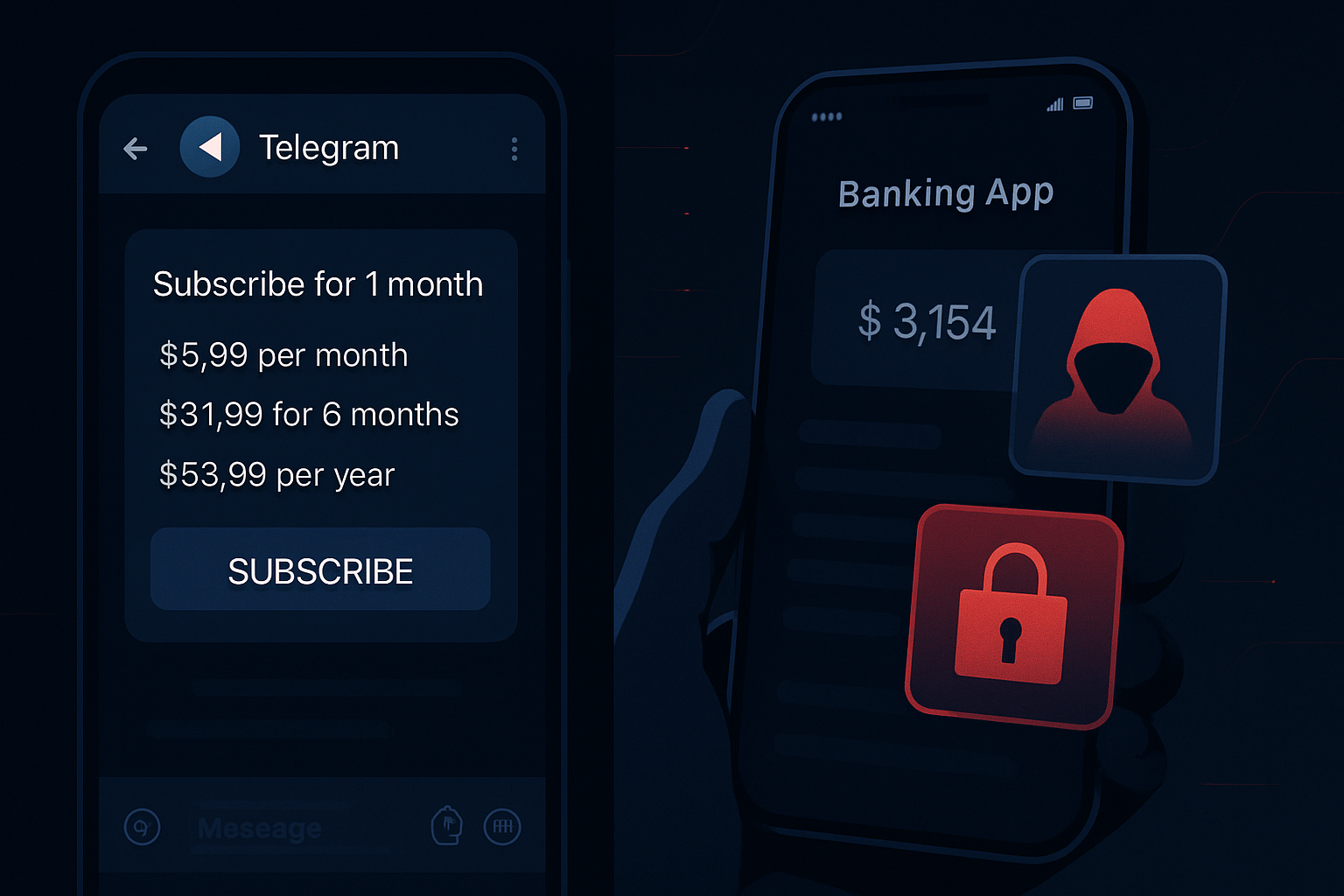
A new Android malware operation called RedWing is being marketed as a rental service on Telegram, charging approximately $300 per month to give even inexperienced operators access to banking-fraud tooling. The service packages remote device control, credential harvesting, and session-hijacking capabilities into a subscription model. According to Zimperium's zLabs, RedWing appears to be a variant of Oblivion, an existing MaaS platform that has been operating in the underground market for some time.
The Mechanics of Malware-as-a-Service
What makes RedWing notable is not technical novelty but business model simplicity. Traditional malware distribution required either direct sales to sophisticated buyers or broad spam campaigns with low conversion. RedWing inverts this: it rents the malware and its command-and-control infrastructure to subscribers who lack the skills or resources to build such tools themselves.
The operational model is straightforward. A subscriber pays the monthly fee, receives access to control panels, and deploys RedWing samples via phishing, trojan droppers, or app stores. Once installed on a victim's device, the malware establishes a remote access session, captures credentials as they are typed, and crucially, intercepts one-time authentication codes sent via SMS or push notification. This last capability neutralises most conventional two-factor authentication schemes, since the attacker controls the device receiving the second factor.
The rental model eliminates friction for low-capability attackers. No development effort. No infrastructure procurement. No need to maintain C2 servers or evade law enforcement. Simply subscribe, deploy, and collect account takeovers. The MaaS operator handles detection evasion, payload updates, and infrastructure resilience.
Infrastructure Economics and Scale
From an infrastructure perspective, RedWing's profitability depends on operational leverage. A $300 monthly subscription might support 50 concurrent subscribers, generating $15,000 monthly revenue. The operator's costs—C2 hosting, malware development, updates—are amortised across the entire subscriber base. This is why offshore and high-privacy hosting providers become critical infrastructure for such operations. C2 servers must be hosted in jurisdictions with weak law enforcement, hosted on infrastructure that doesn't immediately revoke services on abuse reports, or fronted by bulletproof hosting arrangements.
The Telegram distribution channel is equally important. It provides a direct, pseudonymous sales channel that is difficult for conventional law enforcement to monitor in real time. Subscribers join private Telegram groups, verify their payment credentials, and gain access to deployment instructions and control panel logins. The platform's encryption and group privacy make takedown operations slower than email-based MaaS distribution would be.
Detection and Attribution Gaps
The challenge for defenders is that RedWing distributes indiscriminately to anyone with $300 and a Telegram account. Each subscriber deploys the malware independently, using different vectors, timings, and targeting strategies. Traditional IOC-based detection—blacklisting C2 IP addresses or signing keys—becomes less effective when hundreds of independent operators are all using the same malware. The infrastructure looks fragmented even though it is centrally operated.
Mobile device manufacturers and security vendors face an additional problem: RedWing likely employs obfuscation, code injection, and permission-abuse patterns common to banking trojans. Detecting it requires not just signature matching but behavioural analysis. A banking app that suddenly requests accessibility service permissions and attempts to read clipboard data warrants suspension. Scaling this detection across billions of Android devices globally, and maintaining it as RedWing's operators release variants and evasion techniques, is a resource-intensive operation that few organisations can sustain independently.
The Broader MaaS Ecosystem
RedWing is not an outlier. The malware rental market has grown steadily as operators realised that providing tools and infrastructure to low-skill attackers is more profitable than conducting attacks directly. Ransomware-as-a-service, DDoS-as-a-service, and phishing kits have established this model thoroughly. Android malware rental follows the same pattern.
The implication for both defenders and hosting providers is clear. Infrastructure providers face constant pressure to identify and remove C2 servers. Mobile device operators must continuously evolve detection logic. Users must maintain vigilance against installation vectors. The MaaS model makes all of these defences simultaneously harder by distributing attack operations across many actors.
RedWing's $300 price point is deliberately low—a price that makes entry rational for anyone conducting opportunistic fraud. At that cost, even a small percentage of successful account takeovers generates return on investment. The subscription model ensures the operator maintains revenue stability and cash flow, reducing the incentive to disappear or relocate as law enforcement pressure mounts.
Understanding RedWing as an infrastructure operation, not just a malware variant, provides useful context for why detection remains difficult and why MaaS threats continue to proliferate. The business model, pricing, and distribution channel are as important to its success as the technical capabilities of the malware itself.