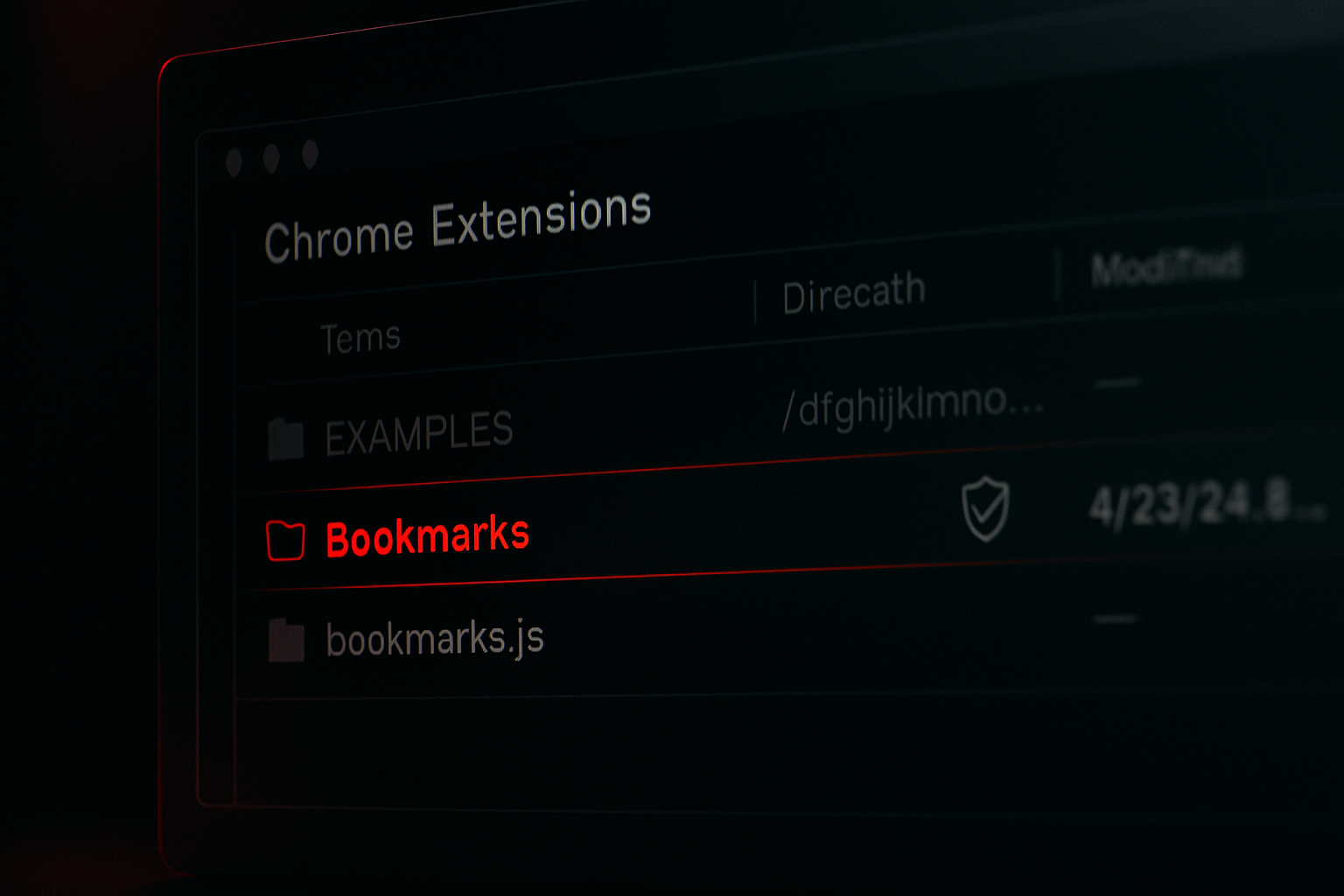
Cybersecurity researchers recently disclosed PEEP, a post-exploitation toolkit that converts Chromium-based browsers into command execution backdoors by injecting a malicious extension directly into the browser profile. For infrastructure operators and hosting providers, this represents a concerning evolution in persistence mechanisms — one that bypasses traditional Web Store validation and user interaction entirely.
How PEEP Achieves Persistent Access
PEEP operates as a post-compromise tool, meaning it requires an attacker to have already gained administrative or code-level access to the target system. Once in place, the toolkit injects itself as a bookmarks extension into Chrome or Edge profiles, using forged Secure Preferences to mask its presence and bypass cryptographic signature checks that Chromium normally enforces. This approach is significant because it doesn't require a user to install anything from the Chrome Web Store or interact with permission prompts — the entire injection happens at the filesystem level.
What makes this technique particularly dangerous is its reliance on browser automation. By operating within the browser context, PEEP gains access to system execution primitives without appearing as a suspicious process. The malware can execute arbitrary host commands, establish reverse shells, and maintain persistent access even if the system is rebooted, provided the browser profile remains intact.
Infrastructure Implications and Persistence Vectors
For server operators, the threat model here extends beyond typical endpoint security. Many administrative and management tasks — from control panel access to deployment tools — occur through browsers. If a server or workstation in your infrastructure becomes compromised, an attacker could inject PEEP into any browser profile on that machine, granting them a stable backdoor that persists across sessions and standard security updates.
The technique also highlights a broader persistence challenge: modern backdoors increasingly hide within legitimate applications rather than creating new processes. Browser-based persistence is particularly insidious because browsers are expected to run, they receive frequent automatic updates, and their internal state is difficult for administrators to audit at scale. A bookmarks extension appears benign, especially to operators who don't regularly inspect browser profiles or extension lists.
Detection and Mitigation for Operations Teams
Detecting PEEP requires a different mindset than traditional malware hunting. File-based signatures are less useful; instead, focus on integrity monitoring of browser profile directories and the Extensions subdirectories within them. On Linux and Windows systems, monitor changes to ~/.config/google-chrome/Default/Extensions or %APPDATA%\Google\Chrome\User Data\Default\Extensions. Any unauthorised extensions appearing there warrant investigation.
Privilege escalation and code execution remain the initial entry point. PEEP cannot function without prior administrative access, so the defensive foundations remain the same: principle of least privilege for user accounts, kernel hardening, exploit mitigations (ASLR, DEP/NX, CFI), and regular patching. On multi-user systems and in shared hosting environments, isolate administrative accounts and use separate systems for infrastructure management.
Browser profile isolation is also worth examining. Consider whether your server administration workflows require full browser access or whether a dedicated, sandboxed management terminal would suffice. Some organisations isolate browser-based management (email, cloud consoles, control panels) on air-gapped or physically separate devices specifically to reduce the blast radius of browser-based compromises.
Broader Context for Infrastructure Security
The PEEP disclosure underscores a trend: attackers are shifting towards living-off-the-land and abuse-of-legitimate-tools strategies. Malware increasingly doesn't look like malware — it masquerades as browser extensions, scheduled tasks, or system services. This makes detection harder and favours defenders who maintain strong logging and monitoring practices.
For hosting providers and infrastructure teams, the message is clear: assume compromise and design for detection. Implement EDR (Endpoint Detection and Response) tools that monitor process behaviour and file system activity. Log browser extension installations and changes. Segment administrative networks. Conduct regular audits of browser profiles on critical systems — particularly those used for hosting control panels, hypervisor access, or datacenter management.
Post-compromise tools like PEEP are a reminder that the security perimeter has collapsed. Attackers already inside your infrastructure don't need to defeat your firewall or patch your externally-facing services — they need only establish a backdoor that survives reboots and avoids casual detection. Browser-based persistence does exactly that.