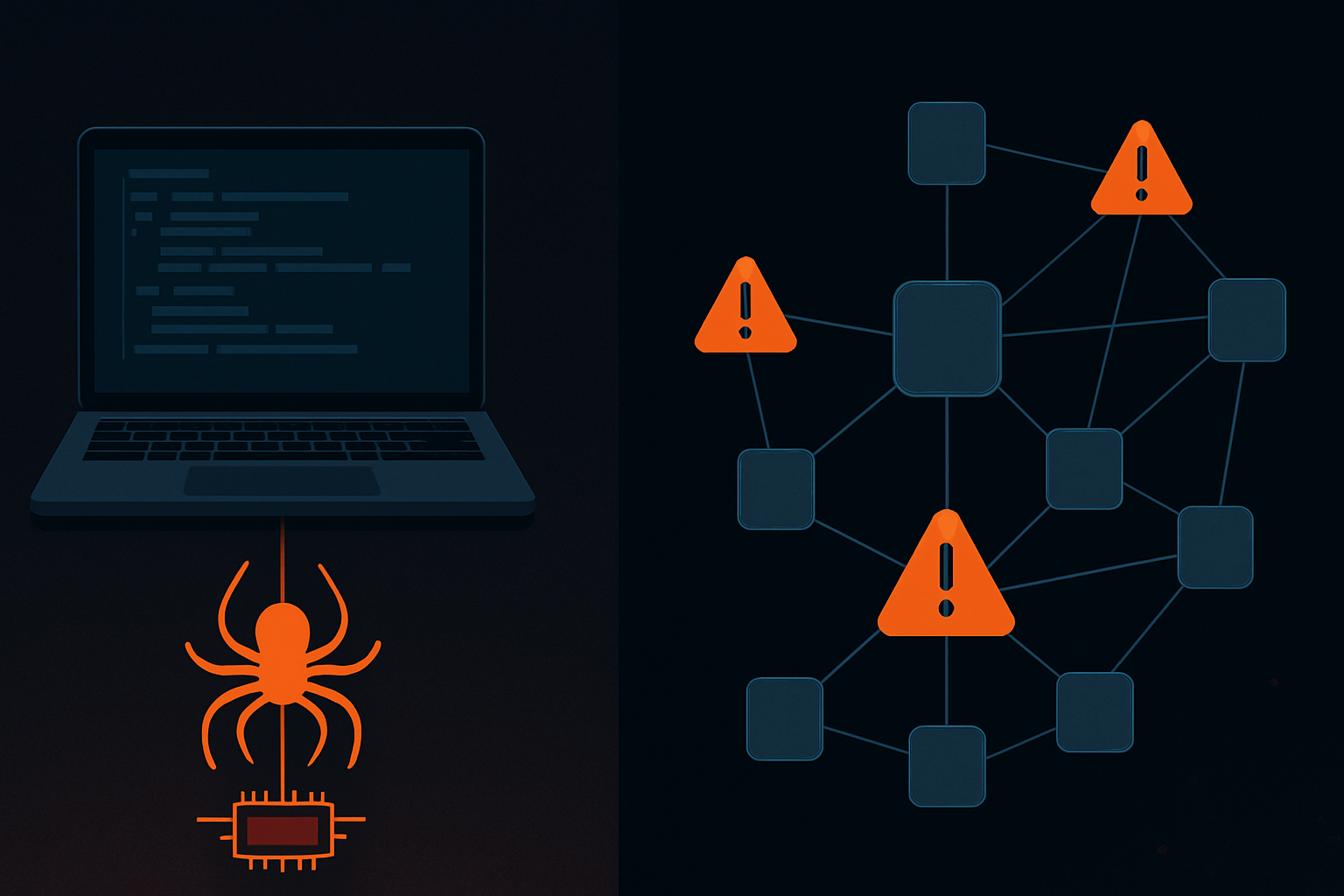
The npm ecosystem has absorbed another wave of supply chain attacks, this time involving both an information stealer and a self-propagating worm distributed across poisoned versions of legitimate packages. These incidents reveal a persistent vulnerability in how modern software dependencies are verified and deployed.
The Attack Surface: Poisoned Packages at Scale
Threat actors compromised or created malicious variants of over 50 packages in the npm registry. Rather than targeting obscure, single-use libraries, the attackers focused on packages with genuine developer usage—increasing the likelihood of installation and execution. This approach differs from previous npm attacks that relied on typosquatting or abandoned packages with minimal downloads.
The dual-payload strategy is notable: one set of packages distributed a Rust-based information stealer, while others contained a self-spreading worm variant called Miasma. The information stealer operates with kernel-level privileges via an eBPF rootkit, allowing it to harvest secrets, credentials, SSH keys, and environment variables from affected machines. The worm's self-replicating design means each compromised system becomes a vector for further distribution, multiplying the attack surface across development teams and CI/CD pipelines.
Detection and Response Challenges
Information stealers using eBPF kernel modules present a detection problem that traditional antivirus and endpoint protection struggle with. The rootkit operates below the visibility level of userland security tools, making it difficult to observe malicious activity without kernel-aware monitoring. Organisations relying solely on package managers' automated security scanning may miss these threats if the scanning tool doesn't inspect compiled binaries or native modules for suspicious system calls.
For development teams, the key response involves auditing installation logs and build artifacts. If your CI/CD system pulled from npm during the attack window, you should assume potential compromise. Regenerating all secrets (API keys, database credentials, deployment tokens) is essential—the information stealer specifically targets these. Checking build logs for unexpected network connections or unusual process spawning can help identify whether the malware executed.
Why Package Managers Remain a Weak Link
npm's model grants publishing privileges to many accounts, reducing the friction for legitimate releases but also the barrier for attackers who compromise developer credentials or create convincing new packages. Checksum verification exists but isn't always enforced at the client level by default. Dependency trees can run dozens or hundreds of packages deep, making it impractical for teams to manually audit every transitive dependency.
This structural challenge extends beyond npm to PyPI, RubyGems, and other language ecosystems. The attack demonstrates that supply chain security cannot rely on trust alone. Organisations should treat dependency updates with the same rigour as external code review: pin versions explicitly, use lock files, and maintain offline verification of critical packages. Where feasible, mirror trusted packages internally rather than pulling directly from public repositories during every build.
Hardening Your Build Pipeline
Infrastructure teams hosting applications built from npm dependencies should implement layered defences. Container image scanning during the build stage can catch known malware signatures, though novel threats will slip through. Runtime restrictions—such as dropping unnecessary capabilities, disabling raw socket access, and confining outbound network traffic to approved destinations—can contain the blast radius if malware does execute.
For organisations running on VPS or dedicated infrastructure, network segmentation between build systems and production is vital. A compromised developer machine or CI pipeline shouldn't have direct network access to production databases or deployment credentials. Implementing secrets management through a central vault (HashiCorp Vault, AWS Secrets Manager, or similar) rather than storing them in environment variables reduces the harm an information stealer can inflict.
The recent npm attacks underscore a hard truth: open-source supply chains will always be a target because they offer attackers scale. The responsibility for defence falls on both package repositories and the teams that consume them. Automation helps, but verification, segmentation, and rapid secret rotation remain your most reliable safeguards.