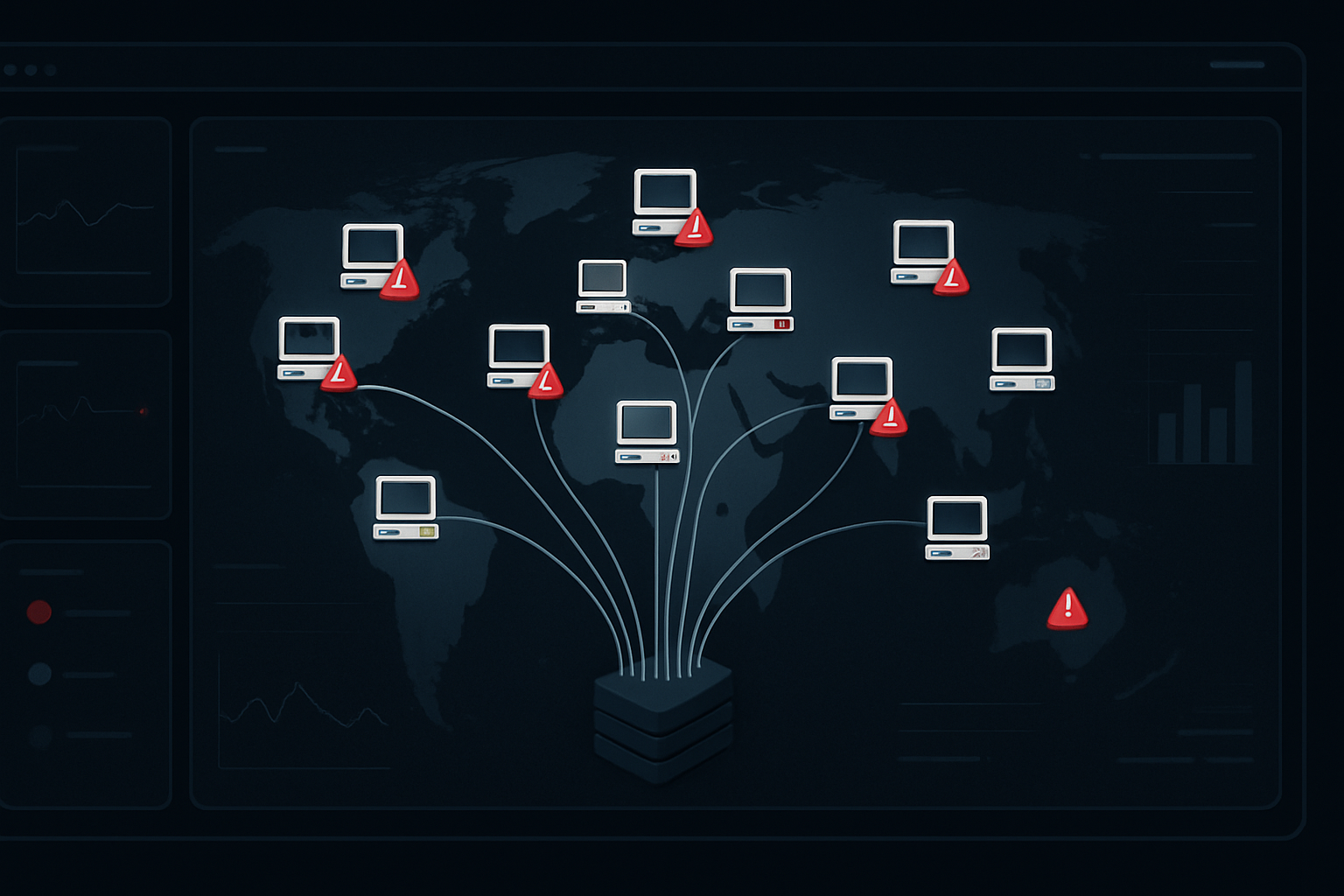
Researchers tracking the JDY botnet have documented a significant expansion of its operational footprint, now commanding over 1,500 compromised SOHO (small office and home office) and IoT devices. The network serves as a distributed reconnaissance platform, continuously scanning for exposed services and mapping network infrastructure at global scale. For infrastructure operators and hosting providers, this represents a tangible threat vector that merits closer examination.
How JDY Operates as a Scanning Platform
Unlike botnets designed primarily for DDoS or spam distribution, JDY functions as what researchers describe as a "high-performance scanner." The compromised devices work in concert to discover and fingerprint exposed services—databases, management interfaces, web applications, SSH ports—across target networks. This reconnaissance phase typically precedes targeted intrusion or exploitation.
The botnet's distributed architecture provides several operational advantages for its controllers. First, the scanning traffic originates from thousands of distinct IP addresses, making it difficult to block or attribute to a single source. Second, SOHO routers and IoT devices often operate with minimal monitoring, allowing botnet activity to persist undetected for months. Third, the sheer volume of devices permits continuous, low-intensity scanning that avoids triggering conventional intrusion detection thresholds.
The choice of SOHO and IoT targets reflects a fundamental supply-chain reality: these devices rarely receive security updates, run outdated firmware, and are deployed with default or weak credentials. A cable modem, WiFi router, or networked printer compromised once becomes a persistent beachhead.
Infrastructure Exposure and Risk Assessment
For hosting providers and infrastructure operators, the immediate concern is that JDY scanning will enumerate publicly facing assets—name servers, mail servers, load balancers, web interfaces. Once fingerprinted, these services become targets for exploitation or further social engineering.
The reconnaissance phase is often the precursor to more sophisticated attacks. Threat actors may target known vulnerabilities in older software versions, attempt credential compromise, or prepare tailored payloads for specific infrastructure. In some cases, the intelligence gathered informs supply-chain attacks or lateral movement strategies.
Operators should assume their infrastructure is being scanned regularly by such botnets. The question is not whether scans occur, but whether your visibility and response capability are adequate. Basic web server logs and firewall telemetry will show reconnaissance traffic—high volumes of port scans, banner grabs, vulnerability probes—from diverse IPs. Aggregating and analysing these patterns helps distinguish opportunistic scanning from targeted reconnaissance.
Defensive and Monitoring Strategies
Several practical measures reduce exposure. First, minimise the surface area of management interfaces. SSH, Kubernetes dashboards, cPanel, and other administrative tools should be restricted to known IP ranges or protected by network segmentation. Default ports are always scanned; moving services to non-standard ports provides minimal security but does reduce noise.
Second, ensure logging and alerting capture scanning and enumeration activity. Tools like fail2ban, WAF rules, and network IDS signatures can detect rapid banner grabs or version probes. Alert thresholds should trigger on unusual scanning patterns—particularly if the same IP attempts connections to multiple unrelated ports in short succession.
Third, maintain inventory of what services are actually exposed. Many organisations discover, during incident response, that legacy services or test environments were inadvertently left accessible. Regular port scans of your own infrastructure, using commercial or open-source tools, reveal what attackers will find.
Finally, coordinate with your upstream provider and security team on observed scanning activity. If your infrastructure is under sustained reconnaissance from a specific botnet or IP range, your ISP or DDoS mitigation service may have contextual intelligence about the campaign.
Broader Implications
The resurgence of JDY reflects a broader trend: state-sponsored actors increasingly rely on commodity botnets and compromised consumer infrastructure for initial reconnaissance. This approach distributes risk, avoids dedicated infrastructure that could be attributed, and exploits the sheer inertia of unpatched SOHO devices. Recent analysis from security researchers suggests the botnet will continue expanding as long as low-hanging fruit remains available.
For infrastructure teams, the lesson is straightforward: reconnaissance is ongoing and will intensify. Defending against it requires visibility into your exposed surface, rapid detection and response capability, and a disciplined approach to access control. In the absence of perfect defence, the goal is to make your infrastructure a harder target than the alternatives—to ensure that reconnaissance alone does not provide enough leverage for exploitation.