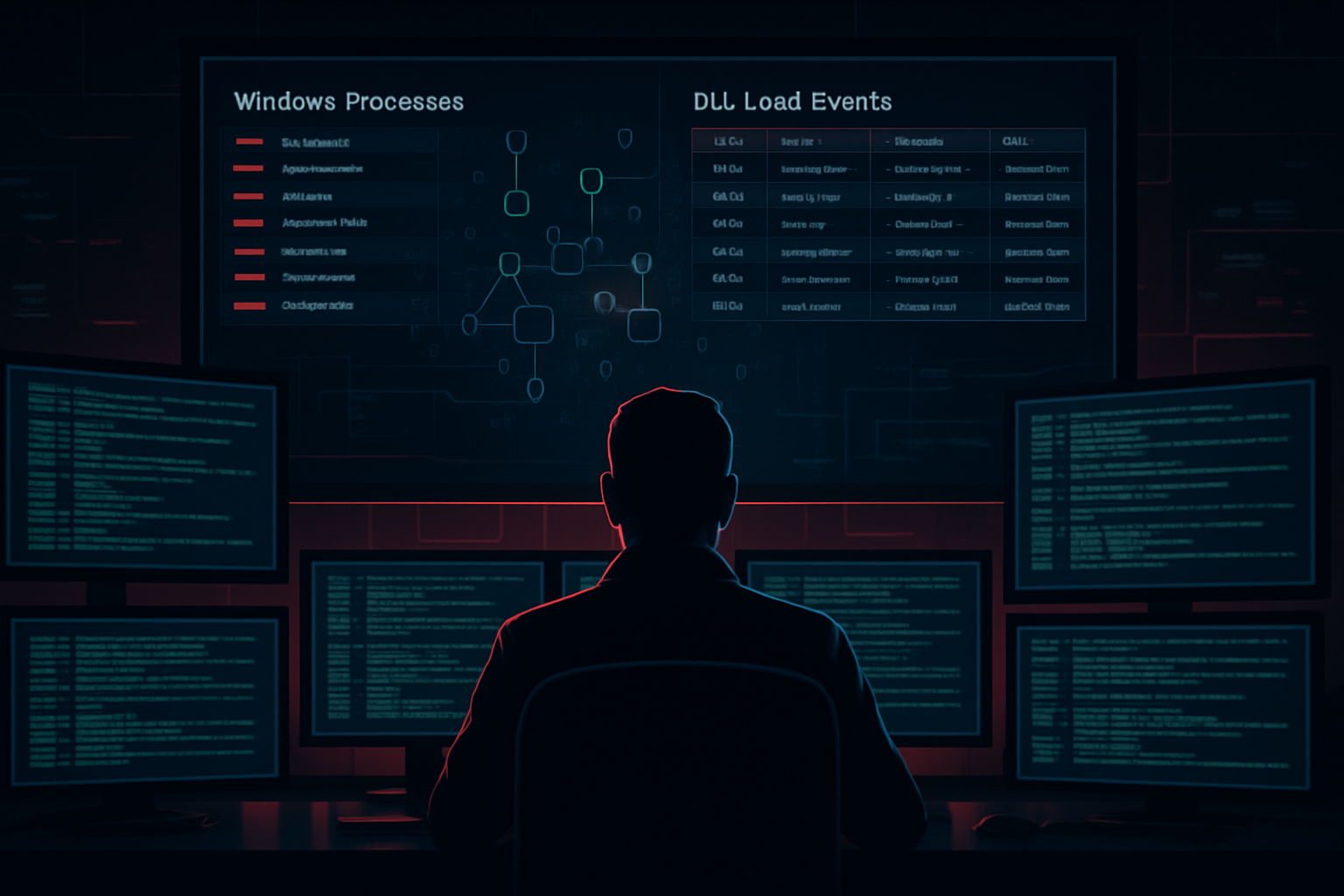
Sophisticated threat actors continue to exploit DLL side-loading as a reliable vector for establishing persistent access within target networks. Recent analysis from Symantec and Carbon Black documents a campaign that demonstrates how this technique bridges the gap between initial compromise and deep infrastructure penetration, particularly affecting industrial manufacturing, financial services, and government facilities across multiple continents.
Why DLL Side-Loading Remains Effective
DLL side-loading exploits a fundamental feature of how Windows resolves library dependencies. When an application loads a dynamic library, the system searches specific directories in a defined order. By placing a malicious DLL in a location where a legitimate application will find it first, an attacker can execute arbitrary code with the same privilege level and context as the trusted process.
The technique is particularly effective against infrastructure operators because it often bypasses conventional endpoint detection tools. A malicious DLL may sit alongside a legitimate, signed executable—one that security teams trust implicitly. The signed binary itself never changes, making signature-based detection ineffective. The attack is also resistant to many application whitelisting solutions that focus on executable names rather than DLL loading chains.
Unlike exploiting unpatched vulnerabilities, DLL side-loading requires no zero-day research. Attackers can use any commonly deployed application that loads external libraries—and Windows is filled with them. This makes the technique available to threat groups with moderate technical capability and infinite patience.
Infrastructure-Specific Risks
For administrators running shared hosting environments, VPS clusters, or dedicated server infrastructure, DLL side-loading poses distinct risks. A compromised tenant account or web application running under Windows can be used as a pivot point to load malicious code with administrative privileges. Once established, the attacker gains a stable foothold that survives application restarts and standard patching cycles.
The targeting pattern observed in this campaign—industrial systems, financial backends, public-sector networks—suggests attackers are focusing on environments where disruption or data theft carries high value. These are exactly the networks that often operate Windows infrastructure alongside legacy applications that have not been updated in years. Older software frequently loads libraries in unsafe ways and may not benefit from modern security hardening.
Financial institutions and industrial operators are also more likely to tolerate slightly elevated endpoint detection noise in exchange for system stability, making it harder for security teams to spot anomalous DLL loading behaviour among legitimate noise.
Detection and Mitigation Strategies
Effective defence requires layered controls. Executable whitelisting is a starting point, but must include DLL loading policies—not just process names. This is more operationally complex than simple blacklisting, because legitimate applications do load external libraries from multiple locations. Testing is essential before deploying in production.
Process monitoring tools should track DLL load events, particularly when a trusted binary loads a DLL from an unusual location or with unusual characteristics (unsigned, recently modified, from a user-writable directory). Alerting on unexpected DLL loads from System32 alternatives—including user directories, temp folders, or network paths—can catch many side-loading attacks before they establish persistence.
Reducing privilege escalation paths is equally important. Applications should run with the minimum required privilege level. If a web service or managed application must run as SYSTEM or Administrator, isolate it in a separate security context where possible. Privilege isolation is difficult to retrofit, so it must be considered during infrastructure planning.
Code integrity enforcement through techniques like Kernel Patch Protection (on supported systems) and Control Flow Guard (CFG) at the application level makes payload execution more difficult even if DLL loading succeeds. These don't prevent the attack but raise the bar for weaponisation.
A Persistent Pattern
DLL side-loading will not disappear because the Windows DLL search order is a design feature, not a bug. Fixing it comprehensively would require breaking compatibility with countless legacy applications. Instead, infrastructure operators must assume DLL side-loading attempts are routine and design detection and response accordingly.
The campaigns targeting critical infrastructure this year demonstrate that sophisticated threat actors see DLL side-loading as reliable enough to build multi-stage operations around it. For infrastructure teams, that should signal the need for DLL-specific monitoring policies and a renewed focus on application inventory—understanding exactly what binaries and libraries are running in production is the foundation for detecting when something unusual loads alongside them.