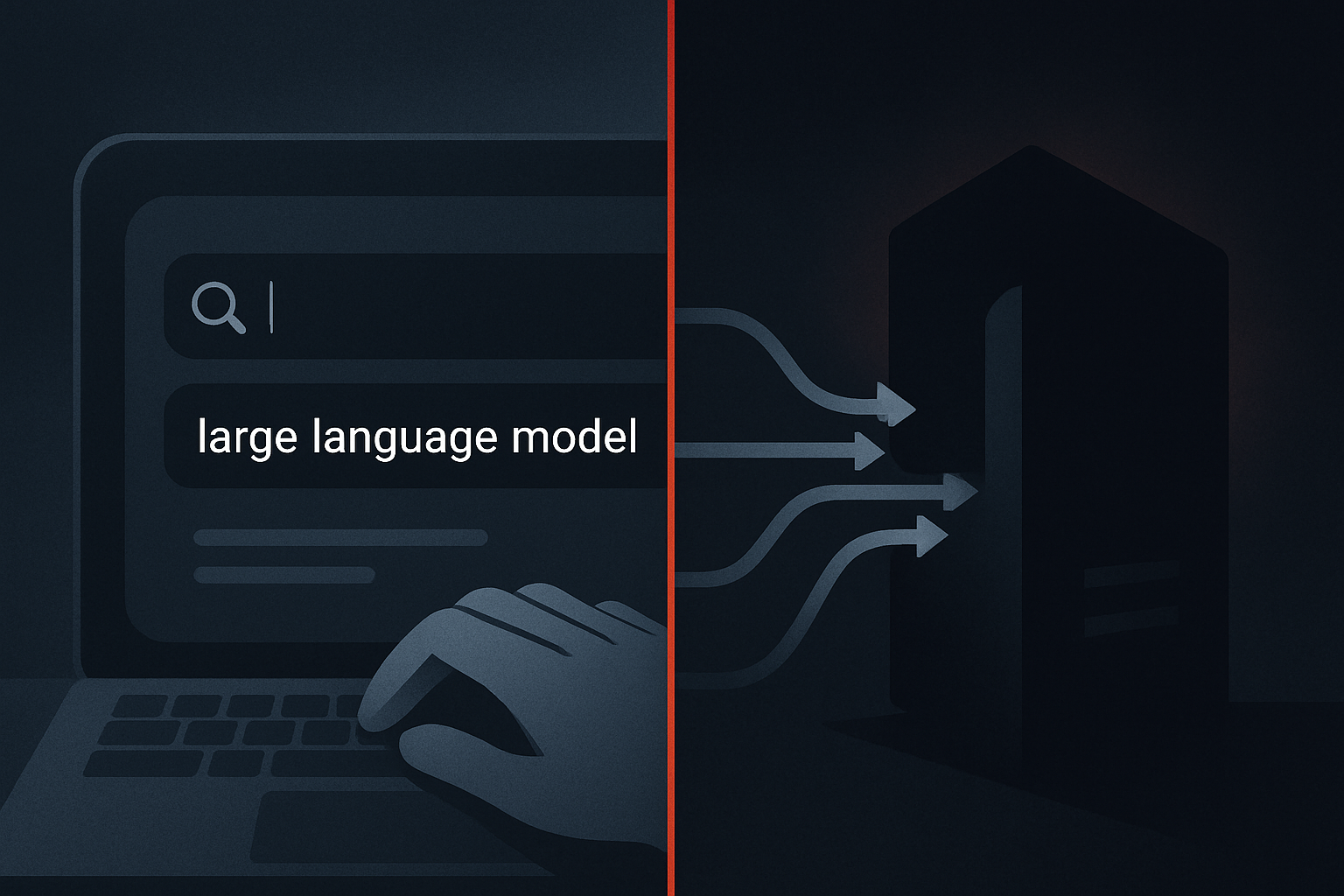
A malicious Chrome extension impersonating the Perplexity AI search engine recently demonstrated a straightforward but effective attack: intercept every search query and keystroke, log them to an attacker-controlled server, then forward users to legitimate results. The technique is neither novel nor technically complex, yet it works because most users don't scrutinise extension permissions closely. The incident, disclosed by Microsoft and subsequently removed from the Chrome Web Store, raises questions that extend beyond consumer safety into the hosting and infrastructure domain.
The mechanics of search interception
The extension operated as a man-in-the-middle at the browser level. By requesting broad content script permissions, it could monitor traffic before encryption, capture address bar input before the browser sent it, and route everything through attacker infrastructure. From the user's perspective, nothing appeared wrong; search results loaded normally, latency was acceptable, and the interface matched the real Perplexity.
This approach is more reliable than network-level MITM attacks because it sidesteps certificate pinning, HSTS headers, and DNS-over-HTTPS. The attacker gains access to plaintext queries before the browser ever establishes a secure connection. For someone searching sensitive topics—privacy-related, health-related, or simply anything they'd rather not expose—the exposure is complete.
Hosting operators and infrastructure teams should note that no amount of server-side hardening, certificate management, or DDoS mitigation prevents client-side interception. When your users' browsers are compromised, the security posture of your hosting layer becomes irrelevant.
The distribution and detection problem
The extension found its way onto the Chrome Web Store, which applies automated and manual review processes. Yet it passed those gates. The typical reason is obfuscation: the malicious code may have been buried beneath legitimate functionality, or permissions were requested in a way that suggested normal browser extension behaviour. Only when Microsoft's security research identified the pattern—unusual network connections, data exfiltration to non-standard IPs—was the threat conclusively flagged.
This highlights a persistent gap in the extension ecosystem. Users cannot reliably distinguish between a trustworthy extension and a compromised one based on store listings alone. Review processes, while improving, are not foolproof. A motivated attacker with modest obfuscation skills and patience can slip past automated checks.
Hosting and privacy infrastructure implications
For providers offering privacy-focused or anonymous hosting services, client-side compromise creates a hard limit on what they can guarantee. A user running a malicious extension can be deanonymised, their queries logged, their activities correlated—regardless of whether they're using an offshore datacenter, a no-logs VPN, or anonymous domain registration. The weakest link is always the user's own machine.
This reality has several consequences. First, it underscores why education matters more than infrastructure alone. Operators should make clear to users that platform-level privacy is necessary but not sufficient; endpoint security is their responsibility. Second, it suggests that any hosting or VPN provider offering privacy guarantees must explicitly disclaim liability for compromised client machines. Third, it indicates that security research at the browser and application level is as critical as network-level work.
What hosting teams should do
If you manage infrastructure used by privacy-conscious or security-sensitive users, consider documenting the threat model explicitly. Include browser extension attacks in your security advisories. Recommend browser hardening practices: disabling unnecessary extensions, using extension management tools, and preferring browsers with stricter permission models.
For those operating anonymous or DMCA-ignored hosting services, the reality is that your infrastructure's legal jurisdiction and content policies matter less if end users are trivially compromised. A malicious extension can reveal not just what users search for, but where their traffic originates, what they're hosting, and how they're using your services.
The Perplexity extension incident is also a reminder that distributed trust—relying on app store reviews, extension sandboxing, and browser vendor security—has real limits. In practice, this means that security-conscious users should maintain skepticism about any unfamiliar extension, even those that appear in official stores, and should assume that their own machine is the primary attack surface.