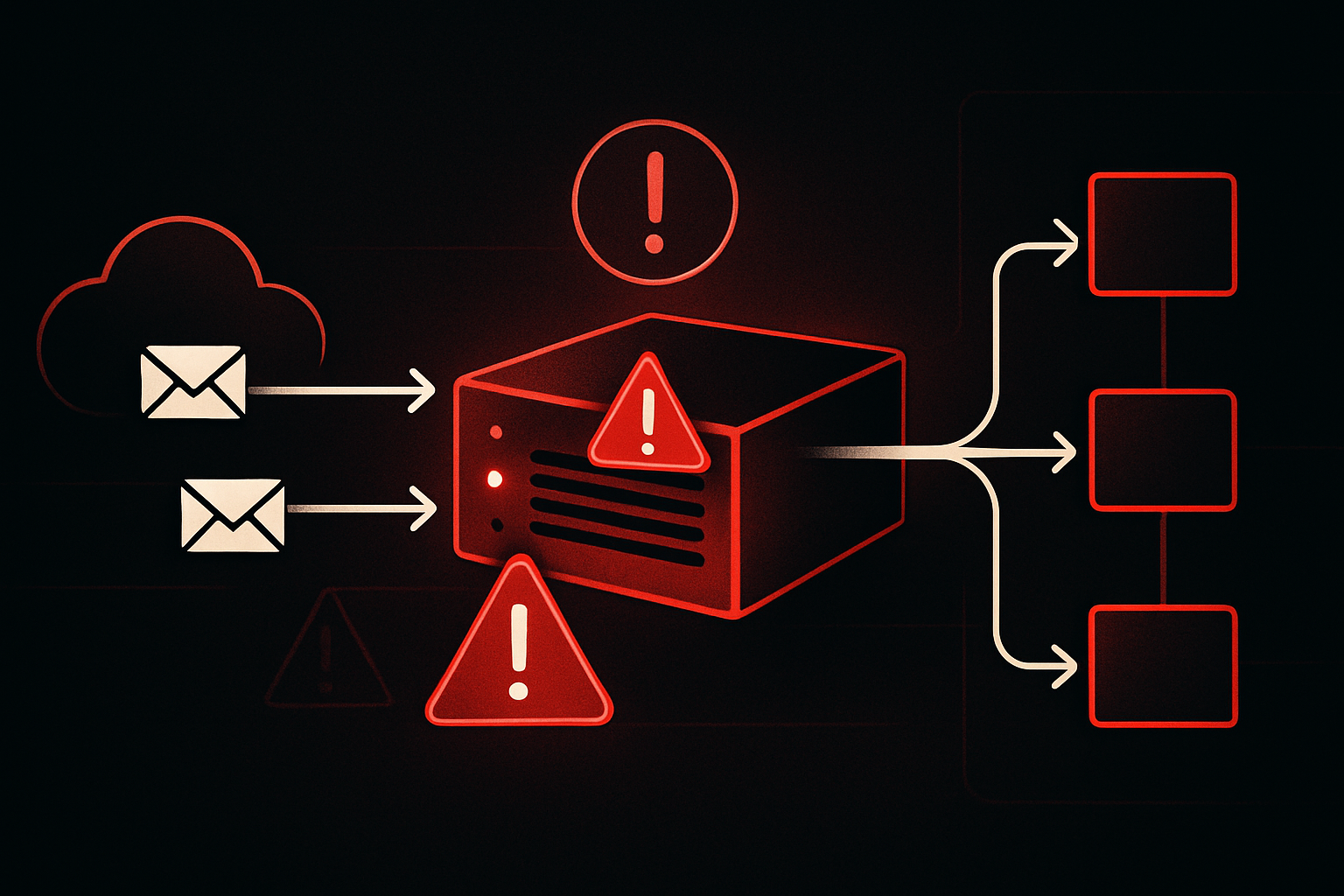
Email gateways occupy a peculiar position in the security perimeter: they sit between the internet and your internal network, filtering what should be filtered while passing through what should pass through. When a critical flaw emerges in such an appliance, the blast radius extends far beyond the device itself.
Cisco recently disclosed a vulnerability in Secure Email Gateway (SEG) that exemplifies this risk. The flaw permits an unauthenticated attacker to craft a specially formed email attachment, send it through the gateway, and gain the ability to execute arbitrary commands with root privileges on the appliance itself. No credentials required. No prior foothold needed. Just a malicious email.
How the Attack Chain Works
The vulnerability operates through a relatively straightforward mechanism. An attacker constructs an email with a crafted attachment designed to exploit insufficient input validation within the gateway's file-handling routines. When the message passes through the appliance, the malformed attachment triggers the flaw, allowing the attacker to write files directly to the operating system.
Once file-write primitives are established, the path to root command execution becomes obvious. The attacker can overwrite configuration files, inject code into running processes, or manipulate system binaries. From that point forward, the compromised gateway operates entirely under the attacker's control.
This is not a theoretical scenario. Cisco's advisory noted active exploitation in the wild, meaning organisations are already discovering these attacks in their logs.
The Perimeter Problem
Email gateways present a particular challenge because they process untrusted input by design. Their entire function is to accept mail from the public internet and make trust decisions about it. A security flaw that turns this role into an attack vector is especially dangerous.
An attacker who compromises the email gateway gains several advantages. First, they can intercept, modify, or exfiltrate email passing through the appliance. Second, they can use it as a pivot point to probe internal networks, since the device typically sits on both the external and internal segments. Third, they can alter email routing, spam filtering, or encryption policies to disable security mechanisms downstream.
Unlike a perimeter firewall, which operates at a lower protocol layer and may have limited visibility into application-level logic, email gateways are application-aware and maintain state about message flows, authentication, and content rules. Compromising one means losing control over a significant portion of external communication.
Detection and Response Priorities
Organisations running Cisco Secure Email Gateway should treat patching as urgent. Cisco released a fix, and the public disclosure means exploit code development or circulation is highly likely (if not already occurring).
In the interim, consider these measures. First, review email gateway logs for any unusual attachment patterns or file-write operations. Second, if patching cannot be applied immediately, implement network segmentation to isolate the gateway and restrict its outbound communication to only what is necessary. Third, ensure the appliance is not directly exposed to the internet; use a reverse proxy or DNS filtering as an additional layer if possible.
Additionally, monitor process execution on the gateway itself. Legitimate SEG operations follow predictable patterns; unexpected child processes spawning from the gateway process or unusual system calls warrant investigation.
Broader Infrastructure Implications
This incident underscores a common weakness in perimeter security architecture: concentrating trust in a single appliance. Many organisations deploy a single email gateway instance or a pair in active-passive failover. If both fail to a common vulnerability, the attacker's task becomes trivial.
Consider diversifying your email security posture. This might mean combining gateway filtering with post-delivery scanning, using DNS-based filtering for inbound mail, or layering multiple vendors' solutions. No single appliance should be the sole arbiter of email integrity.
It also means maintaining asset inventory discipline. Every email gateway, firewall, and load balancer on your perimeter should be tracked, its firmware version logged, and its patch status monitored continuously. A sprawling infrastructure where one appliance is forgotten is an appliance waiting to be exploited.
Email security remains one of the most dangerous attack surfaces any organisation faces. A vulnerability that removes authentication entirely from the equation is the kind of flaw that should drive immediate action, not delayed remediation.