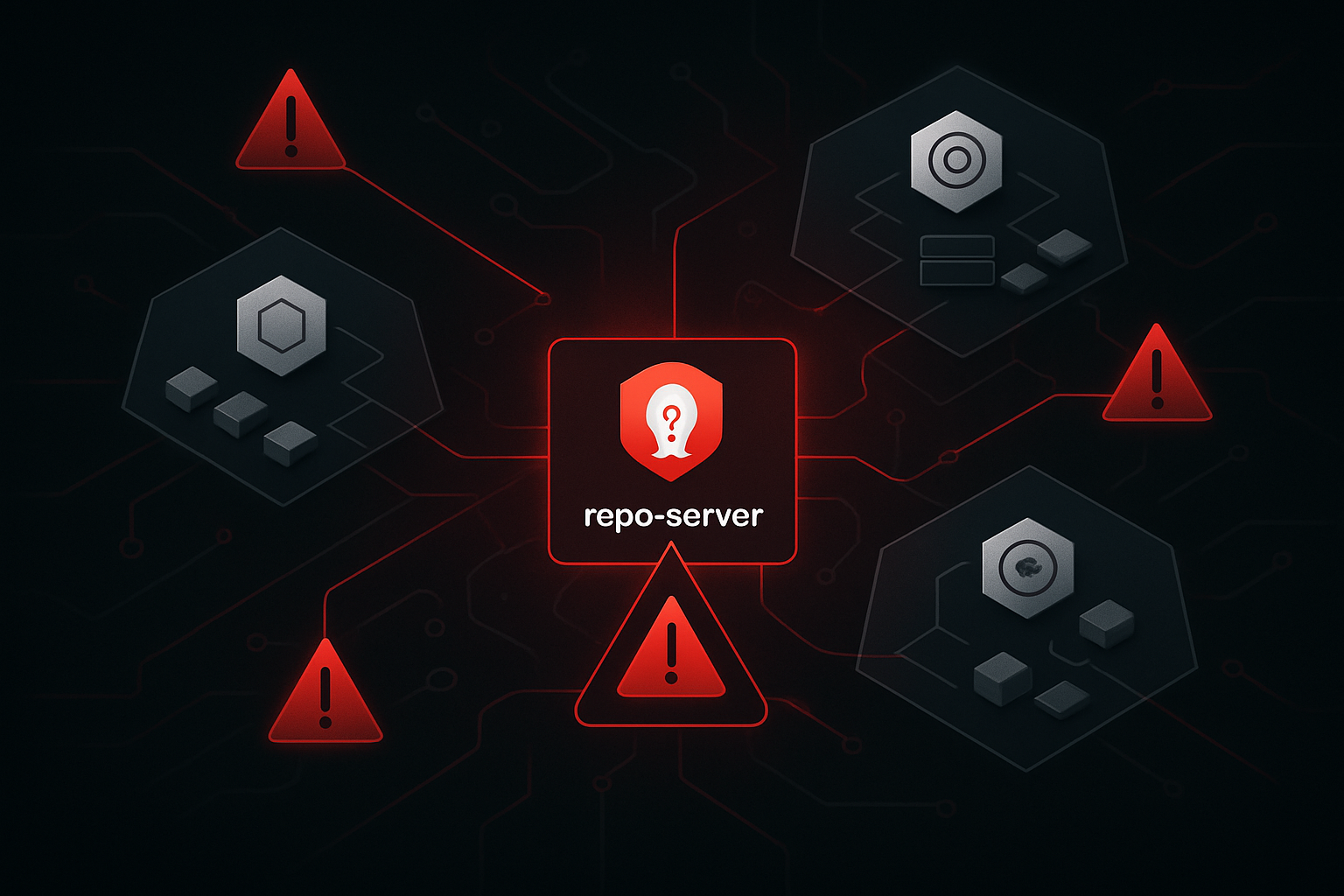
Argo CD, the declarative continuous deployment tool that has become standard infrastructure for teams managing Kubernetes applications, contains a significant remote code execution vulnerability with no public patch. The flaw exists in the repo-server component and requires only network access to the internal port—no authentication credentials needed. For operators running containerised workloads at scale, this represents a material risk that demands immediate attention.
The Attack Surface
The repo-server component in Argo CD is responsible for fetching application manifests from Git repositories and rendering them for deployment. In normal operation, it listens on an internal network port that should only be accessible from other Argo CD components within the cluster. However, misconfigurations—such as exposing the port to the wider network, running Argo CD with overly permissive network policies, or deploying it in an insufficiently segmented cluster—can place this component within reach of an attacker.
The vulnerability allows an unauthenticated attacker who can reach the repo-server to execute arbitrary code with the privileges of the Argo CD service account. In most deployments, this account has broad permissions across the cluster, making code execution equivalent to full cluster compromise. An attacker could then pivot to running workloads, exfiltrating secrets, accessing persistent volumes, or modifying running containers.
Why This Matters for Infrastructure Teams
Argo CD's strength lies in its declarative approach: Git becomes the source of truth for cluster state, and Argo reconciles the running cluster against that state. This architecture makes it attractive for teams managing multiple clusters or embracing GitOps workflows. However, it also means the repo-server is a critical component in your deployment pipeline. Compromising it grants an attacker not just read access to your manifests, but the ability to inject malicious workloads directly into production.
The lack of a published patch compounds the problem. Teams cannot simply apply a security update; they must either wait for a fix from upstream maintainers or implement compensating controls immediately. For organisations running Argo CD in any form—whether self-managed or as part of a larger Kubernetes distribution—this creates operational friction at a time when new exploits may already be circulating.
Immediate Mitigation Steps
Until a patch is available, several mitigations can reduce risk. Network isolation is the most effective: ensure the repo-server port is not exposed beyond the cluster's control plane network. Use Kubernetes network policies to restrict traffic to the repo-server from only the components that require it (typically the application controller and server). If your cluster runs in a cloud environment, leverage security groups or firewall rules to prevent external access to that port.
Audit your current Argo CD deployment for unnecessary exposure. Check any LoadBalancer or NodePort services that might inadvertently expose internal ports. Review your network policies—if they are absent or overly permissive, tighten them immediately. Monitor for unusual connections to the repo-server port; most production deployments will show a predictable pattern of traffic from known components.
Additionally, restrict the permissions of the Argo CD service account to the minimum required for your deployment model. If you do not use certain features—such as the ability to create clusters or manage certain namespaces—remove those permissions from the role binding. This limits the blast radius if the vulnerability is exploited.
Broader Implications
This incident highlights a recurring problem in infrastructure tooling: when a component is designed for internal use only, security assumptions often rely on network topology rather than strong authentication. Developers assume the component will never be exposed, then focus hardening efforts elsewhere. When network assumptions are violated—whether through misconfiguration, cloud-native complexity, or lateral movement by an attacker already inside your environment—the consequences can be severe.
For teams evaluating Argo CD or considering how to deploy it, this is a reminder to treat internal components with the same scrutiny as user-facing services. Zero-trust principles apply to cluster-internal traffic just as much as to the perimeter. The original report indicates no CVE has yet been assigned, suggesting the disclosure process is still ongoing. Monitor the Argo CD repository and security mailing lists closely for patches and additional technical guidance.