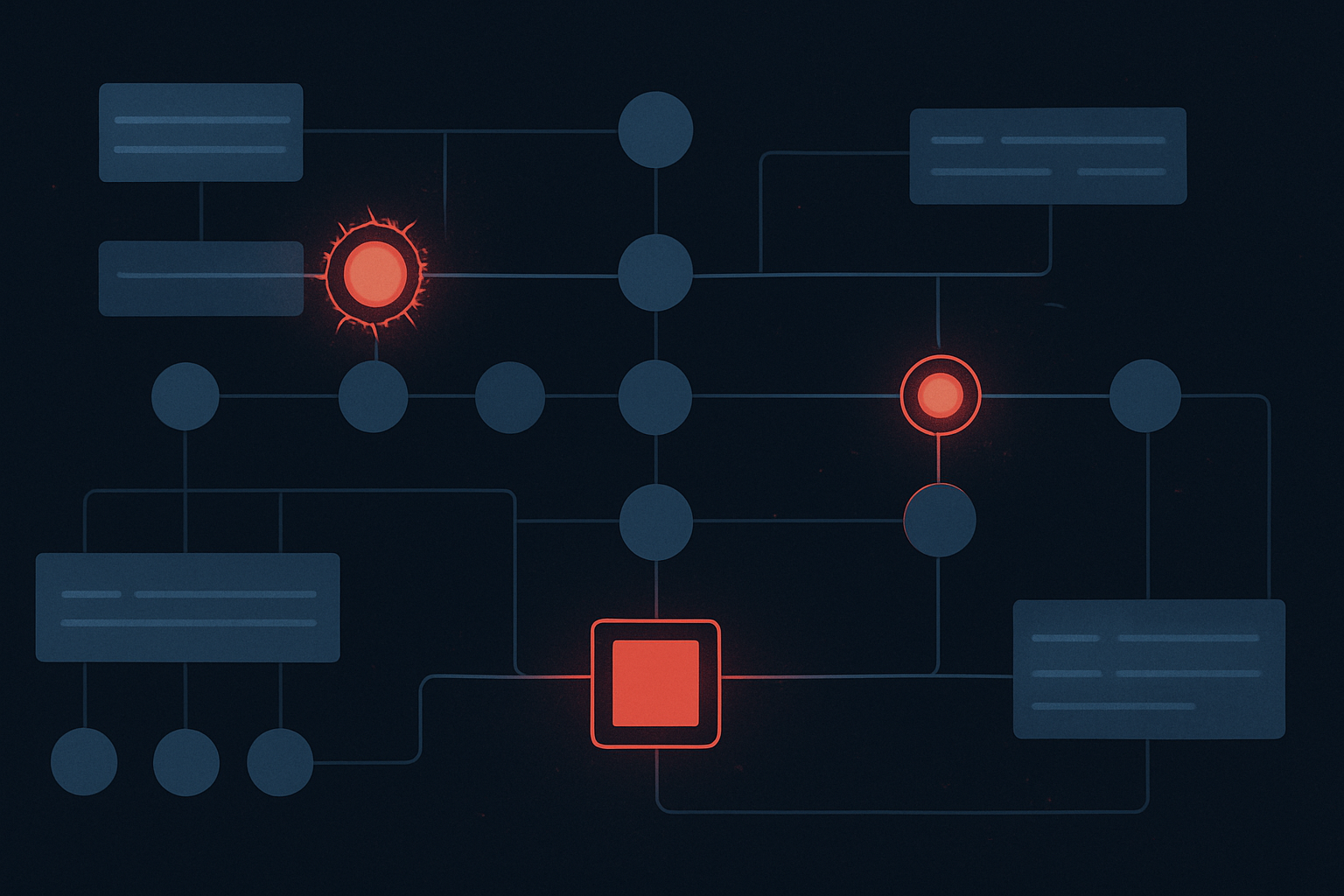
A recent security research exercise demonstrated a pattern that should concern anyone operating web infrastructure: two seemingly minor flaws, when chained together, can grant an attacker complete account access to critical systems. Researchers at Hacktron used Claude Opus 5 to identify and exploit a vulnerability in OpenAI's public help forum software, then leveraged that access to bypass the company's login system and reach internal code repositories.
The Mechanics of Vulnerability Chaining
The attack chain worked as follows: a bug in the help forum software allowed researchers to extract sensitive data or manipulate requests in ways the system didn't intend. Rather than stop there, they used that foothold to probe OpenAI's authentication layer itself. The second flaw—a weakness in the login mechanism—proved to be the critical pivot point. Neither vulnerability alone would have been sufficient; the first provided access to systems within the network perimeter, and the second provided the means to escalate that access to employee accounts.
This is a pattern seen repeatedly in infrastructure breaches. Attackers rarely exploit a single zero-day. Instead, they chain together low-severity issues that, in isolation, might seem acceptable from a risk perspective. A CSRF token weakness here, a session fixation flaw there, a predictable password reset token elsewhere—each one minor, but collectively devastating.
Why AI-Assisted Discovery Matters for Defence
The use of Claude Opus 5 in this research wasn't incidental. Large language models have become efficient tools for vulnerability hunting, particularly when applied to codebases or request patterns. The model can recognize logical inconsistencies, spot deviations from security best practices, and identify potential attack surface areas faster than manual code review. For defenders, this suggests that assuming vulnerabilities will remain undiscovered for long is increasingly optimistic.
The implication for infrastructure teams is straightforward: security testing needs to shift from reactive patching toward continuous probing of your own systems. Assume a capable attacker with AI assistance will discover your chained flaws before your own audits do.
Designing Systems to Resist Chaining
Preventing account takeover via chained vulnerabilities requires several practical measures. First, isolate systems by trust boundary. A bug in a public-facing help forum should never grant access to internal authentication systems. That separation might seem obvious, but it's routinely violated through shared libraries, shared authentication backends, or overly permissive network policies.
Second, implement rate limiting and anomaly detection on authentication endpoints. If an attacker successfully exploits a forum bug to gain a session or token, they'll still need to attempt login bypasses. Unusual login patterns—multiple failures from a newly obtained session, authentication requests to employee accounts from external IPs, rapid password resets—should trigger challenges or temporary account locks.
Third, assume your public-facing code is audited by adversaries constantly. This isn't fatalism; it's realism. Any web-accessible application will eventually be fuzzed, reverse-engineered, and tested for flaws. Sanitise all input strictly, use allowlists rather than denylists, and avoid re-implementing authentication logic. Use well-tested libraries and frameworks instead.
The Broader Lesson
This research, documented by The Hacker News, underscores that the greatest infrastructure risks often aren't single critical flaws but rather the accumulation of small oversights. A help forum bug might seem low-risk in isolation. A password reset mechanism with minor timing predictability might be dismissed as impractical to exploit. But when an attacker can chain them together—especially using AI to accelerate discovery—the risk profile changes entirely.
For infrastructure and operations teams, the takeaway is to review your systems not as isolated components but as an interconnected graph. Trace the potential paths from each public-facing service through to your most sensitive assets. Assume that two or three minor flaws will be discovered and chained. Design your defences accordingly.